


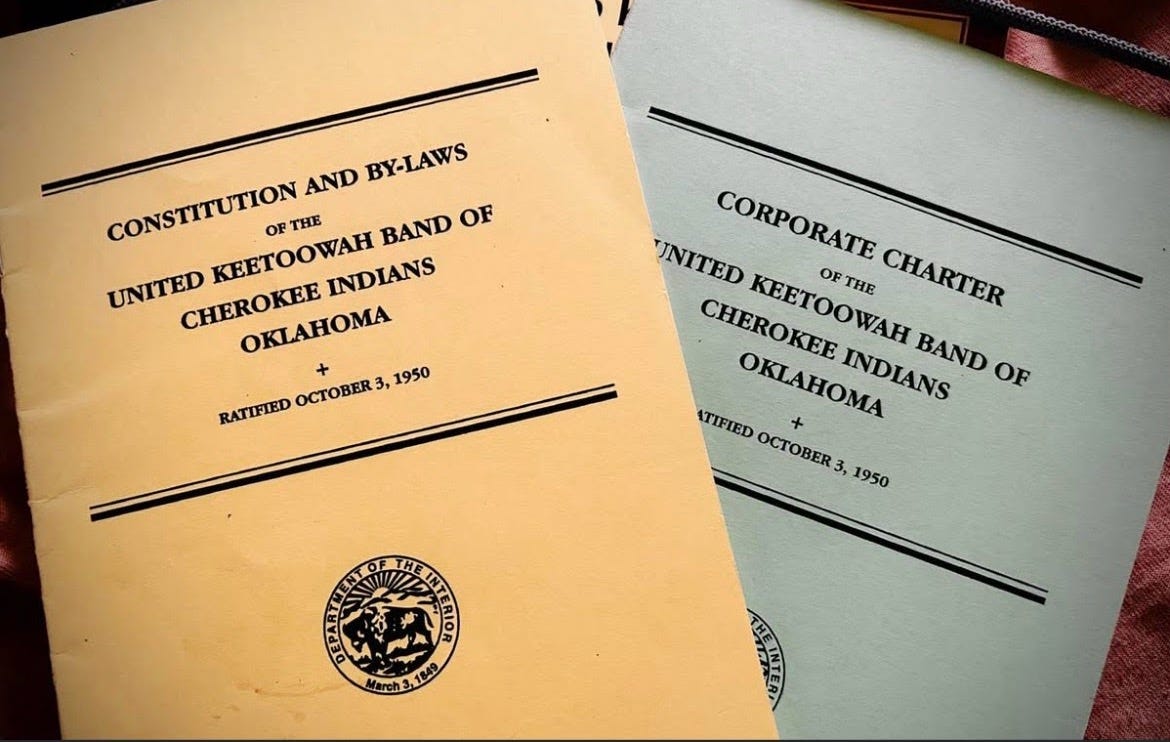
The United Keetoowah Band of Cherokee Indians in Oklahoma’s district representative election is less than a month away. That makes it a good time to know how the Band’s government is set up. The Constitution says who holds the power. The By-laws say what each office is supposed to do. Both are worth keeping in mind as you look at the people asking for your vote and think about what to ask them.
The United Keetoowah Band of Cherokee Indians in Oklahoma is run by its Council. Not the chief. The Council.
The Band’s Constitution calls the Council the tribe’s highest governing body. It has 13 seats. Nine are district representatives. Four are officers elected by voters across the whole Band: the chief, assistant chief, secretary and treasurer. All four sit on the Council. They don’t sit above it.
The Constitution gives the Council wide power to do business and speak or act for the Band. The Council can also hire staff, set up committees, name representatives and hand off some of its powers, as long as it follows the law and its own rules.
The By-laws spell out what the four officers do.
The chief runs the meetings. The chief leads Council meetings and membership meetings, oversees the Council’s business and does the job of a chairman. The chief only votes when there’s a tie.
The assistant chief fills in when the chief is gone. If the chief’s office comes open, the assistant chief takes over until it’s filled in the regular way.
The secretary keeps the records. The secretary works under the Council’s instructions and keeps an accurate record of what happens at Council and membership meetings. The secretary handles the Council’s mail, keeps the membership records, signs off on Council accounts and orders, and turns in a written report at the yearly Council meeting. Council members have the right to look at the secretary’s official records, with the secretary present.
The treasurer keeps the money. The treasurer is in charge of all money the Council holds, no matter where it came from, and has to keep an accurate record of it. The treasurer can only pay out money when the Council votes to do it. Band money has to be kept in a special account. Once that account goes over $50, the treasurer has to be bonded, which works like insurance against loss, and the Band pays for it. The treasurer gives a written report at the yearly Council meeting and any time the Council asks for one.
What it means for members and readers
UKB members elect their district representative and the four officers. The Constitution says members 21 and older can vote. In district races, only voters who live in that district or are signed up with it can vote. Today’s election rules may add other requirements for certain races, but the Constitution sets the voting age at 21.
After the election, the Council holds the power the Constitution and By-laws give it. That means it can do business for the Band, set election rules, set rules for who can become a member, fill empty offices and set up a process for looking into complaints and removing Council members or officers.
That power has limits. The Council has to follow the Constitution, the By-laws and the law. The Constitution makes the Council the top governing body, but it also lays out how the government works and puts rules on some of the Council’s powers.
Members can’t call a Band membership meeting on their own. The chief can call one and has to call one when seven Council members ask in writing. When a membership meeting is called, members have to get at least 10 days’ notice of the time, place and reason for it.
There’s no recall in the Constitution. Instead, Article IX lets the Council set rules for looking into complaints of misconduct and removing a Council member or officer. The person accused has to get a hearing, and it takes a two-thirds vote of the Council to remove them.
Records work differently. The By-laws say Council members can look at the secretary’s official records with the secretary present. They don’t say the same thing for everyday members. That doesn’t settle every question about getting UKB records under other laws or current policies. It’s just what the 1950 By-laws say.
The Constitution also has a Bill of Rights. Article XI says members are free to worship, think, speak, publish, gather and associate without interference. It also says the Constitution can’t take away members’ rights as citizens of Oklahoma or the United States, and it can’t take away a member’s property rights without that member’s consent.
Members have a way to change the Constitution. A change can be proposed by a majority vote of the Council or by a petition signed by 30% of the Band’s eligible voters and sent to the secretary of the Interior. If the secretary approves, the change goes to a vote of the people. It passes if a majority votes yes and at least 30% of eligible voters cast ballots.
With the election less than a month away, these rules are more than old words on paper. They show what the people running for office would actually be responsible for if they win.
So when the campaign signs go up and the promises start, members have something solid to measure them against. Who’s responsible for what? Who has the power to make the call? Who has to keep the records? Who controls the spending? Who answers to the Council? And who answers to the people who elected them?
The Constitution tells us how the government is supposed to work. What that government actually does is something members can check for themselves.
The question isn’t just who’s talking. It’s who’s doing the work the office requires, what the Council is getting done with the power it has, and whether that work is paying off for you and other members.
This guide is based on the Constitution and By-laws of the United Keetoowah Band of Cherokee Indians in Oklahoma, ratified Oct. 3, 1950. The UKB government website still publishes that document as the Band’s Constitution and By-laws. Current ordinances, resolutions and other actions may affect how some parts are carried out, so any claim of a later amendment or change should be checked against the official record.
SOURCES
Constitution and By-laws of the United Keetoowah Band of Cherokee Indians in Oklahoma, ratified Oct. 3, 1950: Constitution Arts. IV, V, VI, VII, VIII, IX, XI and XII; By-laws Arts. I-V.
United Keetoowah Band of Cherokee Indians in Oklahoma, Constitution and By-laws.