

Editor’s note: Troy Littledeer, the candidate discussed in this story, is the publisher of Candy Mink Springs Media LLC, which publishes this report.
TAHLEQUAH, Okla. — The United Keetoowah Band of Cherokee Indians in Oklahoma Election Board found Troy Littledeer ineligible for the Flint District Tribal Council race Sept. 8 and excluded him from the ballot under a five-year “Exclusive Member” requirement contained in the tribe’s 2025 Election Ordinance.
Kristie Bradley, the UKB Tribal Court Administrator, filed the eligibility challenge that led to the ruling. Bradley’s challenge alleged Littledeer had not met the requirement in Election Ordinance Section 501(A)(3)(b) that a candidate be an Exclusive Member “for a period of not less than five years prior to filing.” The Election Board sustained the challenge and found Littledeer ineligible.
Enrollment records attached to Littledeer’s subsequent court filing show he held Exclusive Member status from late 2005 to October 2012, then again from March 2025 to the present. The ordinance does not specify how a period of interrupted Exclusive Member status is to be calculated toward the five-year requirement.
The Election Board did not write the five-year requirement. The UKB Council enacted it as part of the 2025 Election Ordinance. Under Election Ordinance Sections 210 and 211, Board rulemaking authority is limited to procedures “consistent with” the ordinance or matters the ordinance does not otherwise address. Littledeer’s petition for judicial review argues those sections did not give the Board authority to resolve the ordinance’s calculation gap the way it did.
The UKB Constitution and attached Bylaws set out separate provisions bearing on the dispute. Bylaws Article II, Section 3, lists three qualifications for Council office: candidates must be at least 21 years old, reside in the district they seek to represent and be a UKB member. Constitution Article VII, Section 1, separately gives the Council authority to hold elections “under rules and regulations to be prescribed by the Council.” Littledeer’s petition argues that authority does not extend to creating a new substantive candidacy qualification beyond what the Bylaws require, and that any such addition would need to go through the constitutional amendment process set out in Article XII, which requires Council or member-petition initiation, Secretary of the Interior approval and a membership referendum.
Littledeer’s petition also points to the UKB Corporate Charter, which authorizes the Council to “regulate the manner of holding Band elections” and “the procedure of the officers and membership,” and separately states that rights and powers not expressly addressed in the Constitution, Bylaws or Charter “shall not be abridged, but may be exercised by the people of the United Keetoowah Band ... through the adoption of appropriate additions and amendments” to those documents. The petition argues that provision supports requiring a constitutional amendment, rather than an ordinance, to add a new candidacy qualification.
The UKB Courts Act of 2022, Section 715, authorizes the UKB District Court to review final action by the Council or a tribal agency to determine whether that action is constitutional under the Tribal Constitution, authorized by tribal law, and not prohibited by the Indian Civil Rights Act or other federal law.
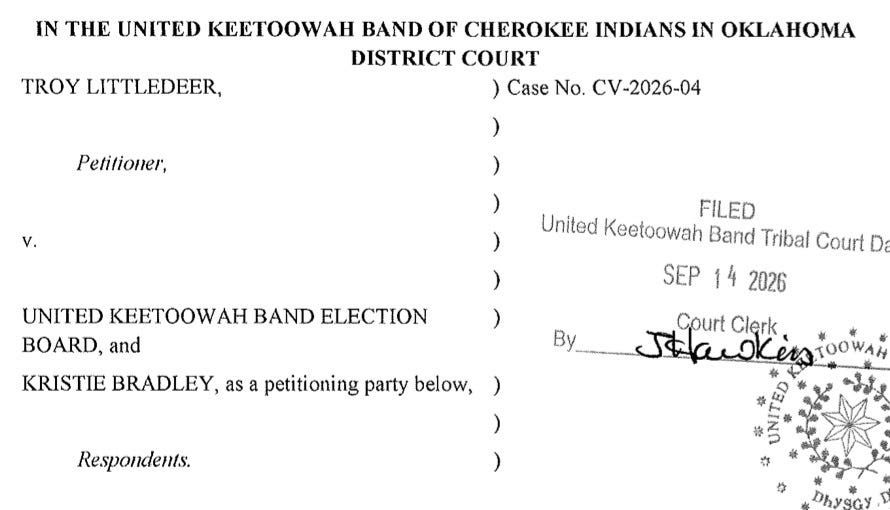
Littledeer filed a petition for judicial review in UKB District Court on Sept. 11, later amended Sept. 14, captioned Littledeer v. UKB Election Board, Case No. CV-2026-04.
“The Board enforced what the Council wrote,” Littledeer said.
The case remains pending before the UKB District Court, which has been asked to determine how the five-year requirement should be calculated when Exclusive Member status has been interrupted, and separately, whether the Council had authority under the Constitution and Corporate Charter to impose that requirement through an ordinance rather than through the constitutional amendment process.