


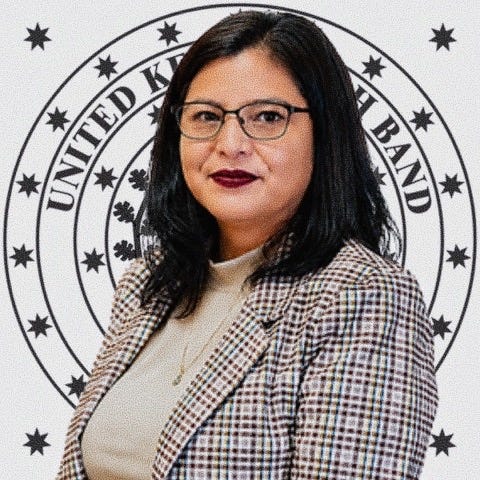
TAHLEQUAH, Okla. — The United Keetoowah Band of Cherokee Indians in Oklahoma Tribal Council met Aug. 14 to consider impeaching Treasurer Sonja Gourd. Hours of executive session later, the council voted 6-5 to dismiss the articles and accept her resignation instead. That’s according to UKB attorney Victoria Holland, who gave the account to the Tahlequah Daily Press.
Six to five out of how many eligible voters is still an open question.
The UKB Constitution builds a 13-member council: nine district reps, four officers. The Canadian District seat’s been empty since this council was sworn in Jan. 4, 2025. No one filed for it in 2024. The Constitution lets the council fill a vacancy for the unexpired term, but it doesn’t require one.
The Impeachment Code seats a hearing panel of nine district reps and four officers, minus the accused. It takes two-thirds to convict. Article IX of the Constitution says the same thing: two-thirds of the council removes an officer.
Here’s where the math splits. Pull the vacant seat and the accused officer, and 11 members are left standing. Two-thirds of 11 is 7⅓, so eight votes convict under that count. But the Constitution doesn’t say however many members happen to be seated — it says the council is 13. Two-thirds of 13 is 8⅔, which means nine votes.
Did anyone produce the document that says which number governs when a seat sits empty and the accused steps out of the room?
The 6-5 vote wasn’t an impeachment vote, and it wasn’t a clean majority either. By Holland’s account, it was a motion to dismiss the articles and accept a resignation. The underlying council vote split 5-5. Chief Jeff Wacoche cast the sixth and deciding vote. UKB bylaws give the chief a vote only to break a tie, and a 5-5 split among council members is a tie.
That squares the earlier math. Nine district reps plus four officers is 13, minus the vacant Canadian seat is 12, minus Gourd herself is 11. If the chief votes only to break ties, 10 members voted first. Ten voting 5-5 is the tie the bylaws require before the chief’s vote counts.
Before any of that, Assistant Chief Amos Ketcher moved to clear the room of non-UKB members and non-family, a category that included people enrolled in both the United Keetoowah Band and the Cherokee Nation. It passed 10-0 among the council members present.
David Cornsilk didn’t leave quietly. He’s a UKB member and a Cherokee Nation citizen, and he told the room his UKB membership entitled him to stay, arguing that removing him over his Cherokee Nation citizenship violated the UKB Constitution.
Article IV puts membership on the roll and hands the governing body authority to set future membership rules. It doesn’t define “Exclusive Member.” Article XI says all members enjoy freedom of worship, conscience, speech, press, assembly and association without hindrance. Neither article says dual enrollment ends UKB membership, and neither spells out an unconditional right to sit in every council meeting.
“Exclusive Member” isn’t a Constitution term. It’s a 2025 Election Ordinance term, one-fourth Cherokee blood minimum, not enrolled in another tribe or band, and it governs election eligibility. The ordinance doesn’t say failing that definition strips someone’s UKB membership for every other purpose of tribal government.
We don’t have the enrollment ordinance or the individual enrollment records that would settle whether Cornsilk and others like him remain UKB members under the roll the council actually uses. Whether the exclusion order violated Article XI remains an open legal question.
Holland told the Tahlequah Daily Press impeachment carries removal, banishment, and disqualification from running for years or for life, and said people can “be banished from UKB property, typically.” UKB law treats banishment and exclusion as two different things: banishment hits a person’s membership rights, exclusion bars someone from UKB jurisdiction and its enterprises. Her phrase isn’t the legal definition of either one without another UKB source backing it up.
What the record shows: the council took up Gourd’s impeachment, split 5-5, watched Chief Wacoche break the tie to dismiss the articles and accept her resignation, and cleared the room of people it called nonmembers, some of them dual-enrolled. What the record doesn’t show: which two-thirds threshold governs when a seat sits empty, whether clearing that room squares with Article XI, and whether UKB law says anything about an officer voting on a colleague’s impeachment while facing articles of his own.
The documents that would close those gaps exist somewhere on UKB letterhead. They just haven’t been produced.