

TAHLEQUAH, Okla. — A United Keetoowah Band of Cherokee Indians in Oklahoma district judge heard arguments July 6 on whether the tribe’s secretary must produce records tied to a Council resolution restructuring the tribe’s media operations, or certify under oath that no such records exist.
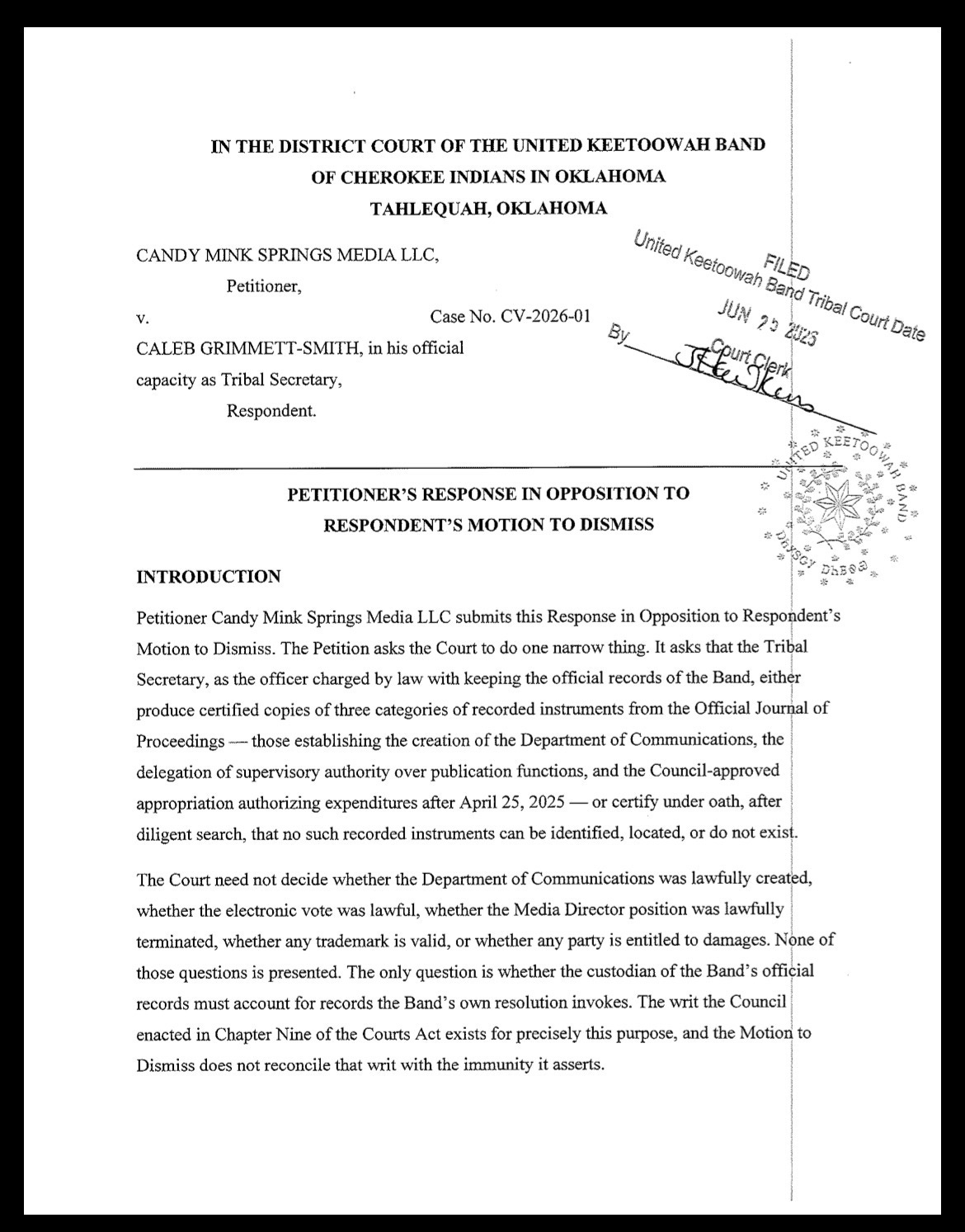
Judge Charles Tripp heard the motion to dismiss in Candy Mink Springs Media LLC v. Caleb Grimmett-Smith, filed March 4 in UKB District Court. Before the hearing, the petitioner filed an amended petition correcting a legal citation identifying the secretary’s recordkeeping duty, along with a response to the motion to dismiss and supplemental notices correcting factual and citation issues.
The amended petition asks the court to compel Grimmett-Smith, in his official capacity as tribal secretary, to produce certified copies of three categories of records from the Official Journal of Proceedings: the formal creation of a Department of Communications, the delegation of supervisory authority over publication functions, and any Council-approved appropriation funding those functions after April 25, 2025. If no such records exist, the petition asks the secretary to certify that fact under oath after diligent search. The petition seeks no other relief.
Resolution 25-UKB-42EV passed the Council on a 7-0 electronic vote April 25, 2025. The resolution states the restructuring will include the transition of the Media Department into the newly established Department of Communications. Littledeer’s sworn affidavit, filed with the original petition, states he requested the underlying records from the secretary Feb. 4, 2026, and that neither production nor certification followed.
Respondent’s counsel, Victoria Holland, filed a motion to dismiss June 17 arguing the petition is barred by sovereign immunity and, alternatively, fails to state a claim. The motion argues a suit against a tribal official in his official capacity is, in substance, a suit against the tribe, citing Lewis v. Clarke, 581 U.S. 155 (2017). The motion states no tribal enactment waives immunity for this type of mandamus action. It separately argues the petition does not adequately allege the elements required for mandamus — a nondiscretionary duty, a clear and indisputable right to relief, no other adequate remedy and circumstances justifying the writ — citing In re JPMorgan Chase & Co., 916 F.3d 494 (2019), and United States ex rel. International Contracting Co. v. Lamont, 155 U.S. 303 (1894).
Littledeer’s response argues the action seeks only to compel performance of a ministerial recordkeeping duty assigned to the tribal secretary under the UKB By-Laws. The response states the court need not decide whether the Department of Communications was lawfully created, whether Resolution 25-UKB-42EV was valid, or whether any party is entitled to damages. The response states the sole question is whether official records referenced by the resolution exist and can be identified, or whether the secretary must certify after diligent search that they cannot.
At the hearing, Holland argued Candy Mink Springs Media LLC, the named petitioner, is not itself a Member of the tribe and questioned its standing to bring the action on that basis. Littledeer is the LLC’s sole owner and is a Member of the United Keetoowah Band.
Holland’s motion also argues granting the writ would be against public policy, characterizing the petition as furthering what it calls Littledeer’s improper and illegal attempts to extract payments from the tribe. The motion cites invoices Littledeer sent the tribe in January 2026 seeking payment for use of the trademark Giduwa Cherokee News, which Littledeer registered with the Oklahoma Secretary of State on May 8, 2025. The motion calls the underlying trademark claim bogus and asks the court to reject what it describes as an attempted shakedown. The petition does not raise the trademark dispute or seek payment. Littledeer’s response argues the trademark materials are collateral because the requested relief is limited to identifying or certifying the existence of official records.
Littledeer filed a notice July 6 identifying three citation errors in Holland’s motion: Santa Clara Pueblo v. Martinez cited with an incorrect volume number, Michigan v. Bay Mills Indian Community cited with a digit omitted from its volume number, and Cheney v. United States District Court for the District of Columbia cited with the decision year given as 2024 rather than 2004. Holland characterized the errors as typographical during the hearing.
Tripp took the motion under advisement. He told the parties he expects to rule by the end of business July 31.