


The United Keetoowah Band of Cherokee Indians in Oklahoma has two sets of rules for who gets to vote, and they don’t say the same thing. One is the UKB Constitution. The other is the election ordinance the Tribal Council passed Dec. 6, 2025. The constitution lets every member who’s 21 vote. The ordinance only lets members vote if they can prove they’re at least a quarter Cherokee by blood and don’t belong to any other tribe.
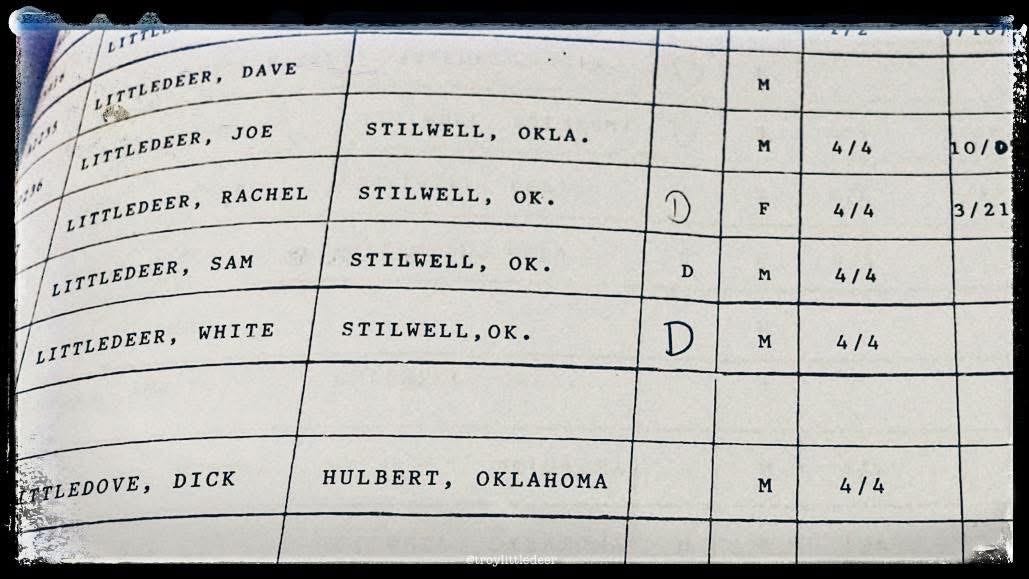
Start with the constitution. It was ratified Oct. 3, 1950, and it says the band’s members are the people named on a roll approved April 19, 1949. Now my great-grandfather Sam Littledeer is on that base roll. The constitution lets the council write rules for “future membership,” meaning who can join after that. On voting, Article VII, Section 2 says: “All members of the Band, twenty-one (21) years of age and over, shall be eligible to vote in any election.” If you’re a member and you’re 21, you can vote. To run for a council seat, Bylaws Article II, Section 3 says you have to be 21, live in the district and be “a member.” The word “exclusive” isn’t in the 1950 constitution, and neither is blood quantum.
The council did write rules for who could join. The Membership Ordinance of 1990 says everyone “of Indian blood” on the 1949 roll is a full member, with no fraction attached. New applicants needed at least one-quarter Cherokee blood, or 25%, to be full members, and they could prove it with sworn statements from three elders and a two-thirds council vote. The same ordinance let people under a quarter in as associate members. They got a card, but the ordinance called their membership “non-voting,” and they couldn’t hold office. In June 1994, the council stopped taking associate members and started requiring new applicants to show a Certificate Degree of Indian Blood, the federal card most people know as a CDIB, at a quarter or more. A note printed in the ordinance says that change “did not affect any previous membership decisions.”
A year and a half before that, on Jan. 9, 1993, the council passed Resolution 93-UKB-01. According to the tribe’s compiled copy of the ordinance, it says being on the 1986 roll of full members, or enrolling later as a full member, is a “final determination” that you meet the quarter-blood minimum. It also says the blood degree printed on your UKB enrollment card counts as the tribe’s blood certificate “for all purposes,” and a federal CDIB showing the same degree works too. The tribe settled the blood question when it enrolled you.
The election ordinance, adopted by Resolution 25-UKB-132, works off its own definitions. Section 104(G) says an “Exclusive Member” is a member who “can prove ¼ degree or more of Cherokee Indian blood” and isn’t enrolled in another tribe. Section 104(I) says “Member” means Exclusive Members only. You have to be an exclusive member for six months to vote under Section 401 and five years to run for office under Section 501, and Section 104(J) holds precinct workers to the same standard. Being a UKB member isn’t enough under the ordinance. You have to be an Exclusive Member. That word isn’t brand new, though I haven’t seen a document showing whether earlier ordinances tied it to a quarter. A 2018 petition filed in UKB District Court quotes an Election Board letter saying the 2012 Election Ordinance required candidates to be exclusive members.
So the constitution says every member who’s 21 can vote, and the ordinance says only members who can prove a quarter blood degree and belong to no other tribe can vote. Some of that lines up. Under the 1990 Membership Ordinance, a UKB member who enrolls in another tribe gives up UKB membership, so that person isn’t a member under either document. Associate members never had the vote under the 1990 rules, and the 2025 ordinance doesn’t appear to change that. The tribal secretary builds the list of eligible voters under Section 404 of the election ordinance. That section tells a member how to get a name added, and Section 405 lets that member go to court if the secretary says no. Nothing in either section gives anyone a way to question a name already on the list, and Section 408 makes the list confidential.
The split comes with the blood requirement. If you’re a UKB member under the constitution and the membership ordinance, but you can’t prove a quarter the way the election ordinance requires, the two documents give different answers to whether you can vote. The council has a real case for its side. Article VII, Section 1 lets it write “rules and regulations” for elections, and the voting clause limits district races to “qualified electors,” a phrase the constitution never defines. Article IV, Section 2 gives it power over future membership, and the tribe has required a quarter for full enrollment since at least 1990. The ordinance also adds residency time, a driver’s license and a high school diploma for candidates, so the council clearly sets some election rules.
Members have a case too. Writing rules for how an election runs, and for who can join the tribe, is one thing. Deciding that people who are already members can’t vote is another. The 1990 Membership Ordinance says enrolled members hold every right the constitution gives them. UKB Attorney General Opinion 2013-01, which is advisory, says “Enrolled Member” covers both original members and people who enrolled later, with the right to vote and hold office. And the constitution has its own way to change who votes, spelled out in Article XII as a proposal, approval from the secretary of the interior and a referendum where at least 30% of eligible voters cast ballots.
Then there’s the word “prove.” Section 104(G) says you must be able to prove a quarter, but it doesn’t say what counts as proof. If your UKB enrollment card counts, the way the 1993 resolution says it should, then a full member whose card shows a qualifying blood degree already has the tribe’s proof. If the Election Board wants something else, like a federal CDIB, then a full member whose CDIB reads under a quarter could lose the vote while keeping the membership. The ordinance doesn’t say which, and I haven’t seen a record of the board turning anyone away on blood quantum, whether by UKB card, by CDIB or by any other paper.
Under Article III, Section 2, one of the band’s stated objectives is securing federal benefits for members through “relief,” “welfare, education, health and other programs,” and under Bylaws Article I, Section 4, tribal money is paid out “in accordance with the vote of the Council.” The people UKB members elect make those calls. A person can be 21, enrolled and carrying a UKB card, and under the ordinance’s words still not count as a voter if they can’t prove a quarter the way the board decides it wants it proved. That person would still live with every council decision on programs and money and have no say in who makes them. Section 104(G) has been tribal law since Dec. 6, 2025, and it doesn’t say what a member has to show to prove a quarter.
SOURCES
UKB Constitution and By-laws, ratified Oct. 3, 1950: Art. III, Sec. 2; Art. IV, Secs. 1-2; Art. V, Sec. 1; Art. VII, Secs. 1-2; Art. XII; Bylaws Art. I, Sec. 4; Bylaws Art. II, Sec. 3.
UKB Membership Ordinance of 1990, Res. 90 UKB 9-4: Secs. 1(B), 1(K), 2(A)(1), 2(A)(3)(c), 2(B), 3(A)-(B); note on June 1994 CDIB requirement and Res. 93-UKB-01 as quoted in the compiled ordinance.
UKB Attorney General Opinion No. 2013-01, Feb. 13, 2013.
UKB Election Ordinance of 2025: Secs. 104(G), 104(I), 104(J), 401(A), 404, 405, 408, 501(A).
UKB Resolution 25-UKB-132, Dec. 6, 2025.
Petition, Tidwell v. UKB Election Board, No. C-2018-2, UKB District Court, 2018.