
THE RULE THAT ONLY SHOWS UP WHEN SOMEBODY NEEDS IT
Commentary by Troy Littledeer


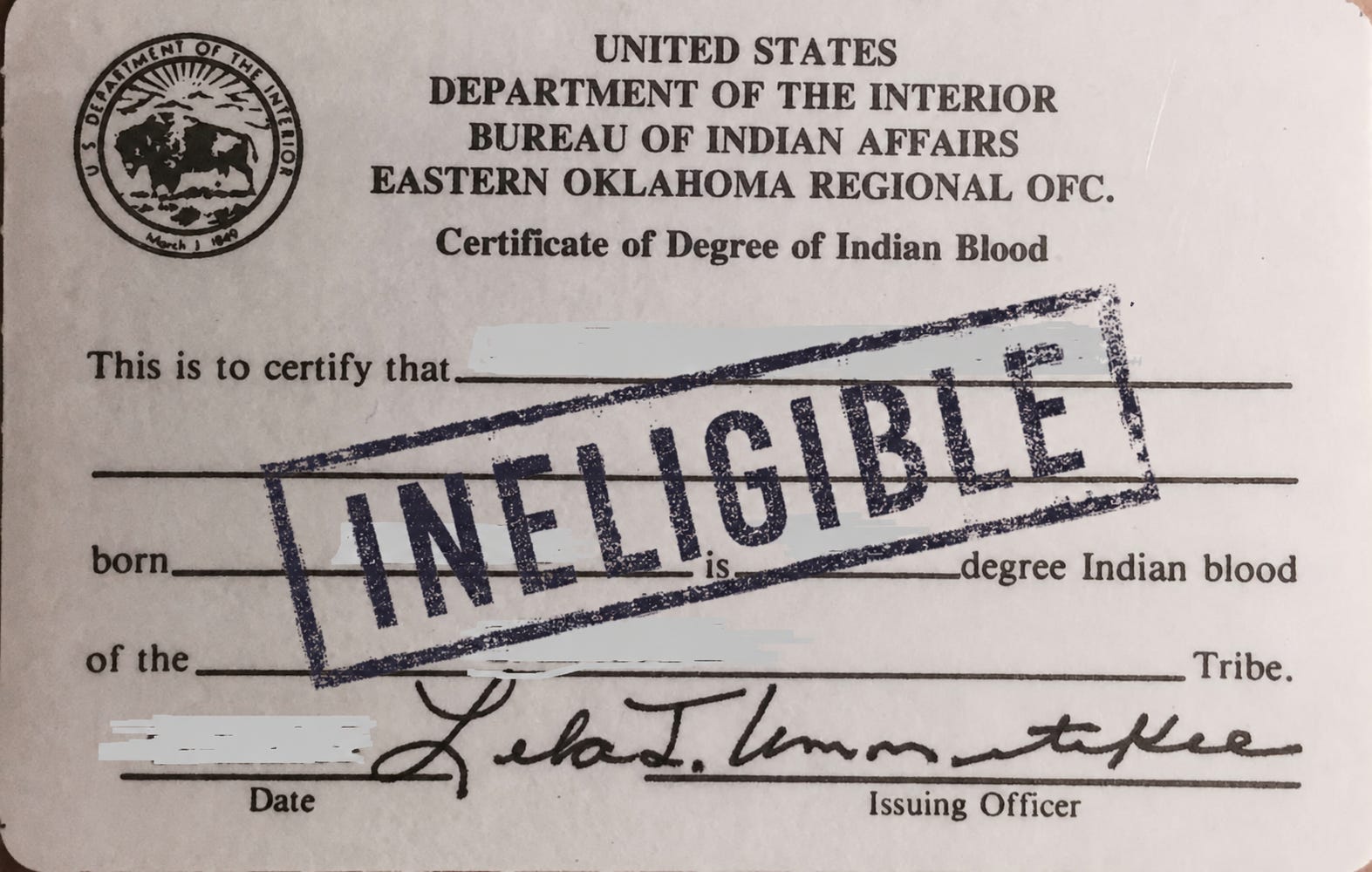
Nobody got turned away at the table during the last election. The quarter-blood line in the United Keetoowah Band of Cherokee Indians in Oklahoma’s own Election Ordinance doesn’t work like a wall. Most Members walk over it their whole lives and never feel it move.
UKB Election Ordinance Section 104(G) defines “Exclusive Member” as one-quarter degree Cherokee Indian blood or more. Section 401(A)(2) says that’s who gets to vote. On paper, it reads solid. Section 407 tells a different story. The Precinct Book, the document that actually enforces the blood-quantum line, only comes out “in the event a question arises.” No question, no Precinct Book. A Signature Book alone is enough to hand somebody a ballot.
The rule sits in the law doing nothing until somebody with the standing to ask decides to ask.
The Election Board didn’t write that setup. Council did. The Board runs elections under an Ordinance that hands them a Precinct Book only meant to come out when a question gets raised, and no instructions on what counts as one. They’re enforcing the rules they were given, not the rules they’d have picked for themselves.
Quarter-blood math goes back further than this Ordinance. It came out of federal allotment-era bookkeeping, built to shrink tribal rolls, not protect them. A 2025 ordinance running that same math, and leaving its enforcement up to whether a question happens to come up, is the same idea wearing newer clothes.
The Ordinance doesn’t require the same screening in Delaware District that it requires in Flint. It doesn’t require the Secretary to write down why one application got a second look and another didn’t. Nine districts. Nine sets of local habits. One rule that only has to get loud in the district where somebody wants it loud.
An unchecked name on a Voter List is a vote nobody bothered to question. A questioned name is a vote somebody made expensive. Council seats get decided in that gap. A treasurer’s impeachment vote gets decided in that gap. Whether the furlough list grows gets decided in that gap.
None of that answers where the blood-quantum line came from to begin with.
The UKB Constitution’s own voting article, Article VII, only asks two things of a voter. Are you a member. Are you twenty-one. Nothing about blood degree. The only power Council holds anywhere near this subject is in Article IV, Section 2, and that’s a membership power, “rules and regulations governing future membership.” It isn’t a voting power. The Ordinance took a rule meant for membership and used it to add a requirement to a voting article that never had one and never gave Council the authority to put one there.
The Constitution lays out its own path for changing Article VII. Article XII. A Council majority or a petition signed by 30 percent of eligible voters, then sign-off from the Secretary of the Interior, then a referendum where 30 percent of eligible voters have to show up. The Corporate Charter backs that up in Section 7. Any right the Constitution, Bylaws, or Charter don’t already spell out stays as it is, unless it’s changed through an amendment to one of those three documents. Not through an ordinance.
The 2025 Election Ordinance never went through Article XII. It went through as an ordinance, and it added a voting requirement Article VII never had, using a power Article IV, Section 2 never gave Council to use that way.
No Tribal Court has ruled on any of it. No Secretary or Election Board chairman has said on the record why the check runs hard in one district and stays quiet in another.
SOURCES 2025 UKB Election Ordinance, Section 104(G), Section 401(A)(2), Section 404, Section 407 UKB Constitution and By-Laws (1950), Article IV, Article VII, Article XII UKB Corporate Charter (1950), Section 7
 | A guest post by
|