



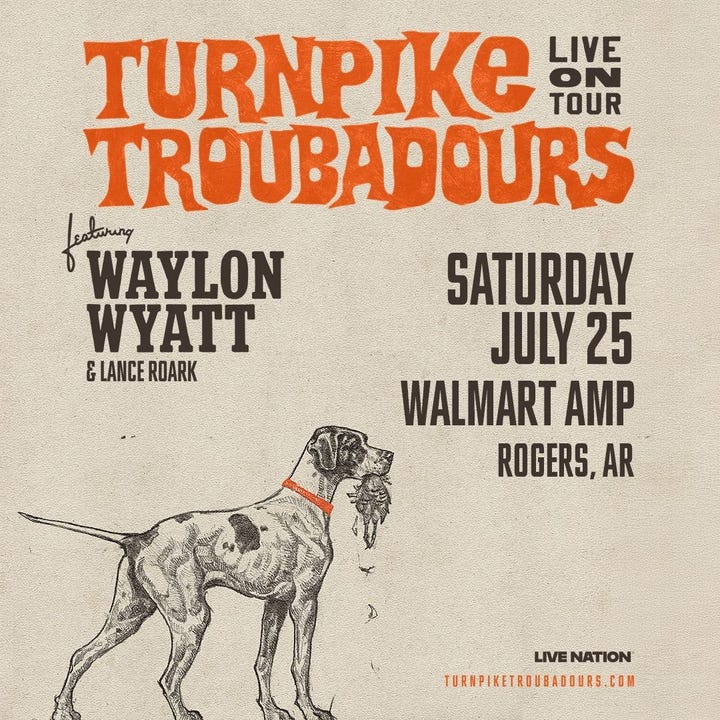
Chris Augerhole calls it his little board box, and once it’s up on stage right at the Walmart AMP, low enough to stay out of the lights, nobody out on the lawn will ever know it’s there. “I’ll be hiding,” he says. That’s the job, in his own words. Hiding, for two and a half hours, with a screen full of lyrics in case Evan Felker needs them.
His day starts at 9 a.m., when the trucks back into the loading dock. Twenty thousand people will fill Walmart AMP in Rogers, Arkansas, and never see any of it. The cable runs. The lines tested twice. The hours of nothing that come after.
Augerhole is a Cherokee Nation Citizen, born and raised in Cherokee County, Oklahoma. By his own count, he’s been doing some version of this for twenty years, the exact lifespan of Turnpike Troubadours.
In the dead stretch between soundcheck and showtime, when younger crew members go looking for water or kill time on their phones, Augerhole mostly sleeps. “It’s not like the ‘80s,” he says. “It’s not Almost Famous.”
Twenty years ago none of this existed yet. Augerhole was just a guy riding around to bars in Texas with Felker and bassist R.C. Edwards, before Turnpike Troubadours was a name that meant anything. Nobody offered him work. He was already there.
The work, when it came, didn’t pay well. Jason Boland and the Stragglers hauled Turnpike around as an opener in those years. Augerhole tagged along, selling shirts out of the back of whatever room would take them. “Didn’t make any money,” he says. No bitterness in it, just the record of how it was.
Goodbye Normal Street broke in 2012, an album named for the Tahlequah street where Felker and Edwards lived while a lot of those songs got written, and the rooms started growing. By the time the self-titled record landed in 2015 and the venues had turned into arenas, somebody on the crew handed Augerhole a business card that stuck: Tele Tech. The title means exactly what it sounds like. He sits behind the board box with a screen, ready to feed Felker a verse the instant a setlist goes sideways.
His father, Herman, is a familiar figure in area basketball, a longtime official who spent years working high school games and just as many doubting where his son’s road was headed. That changed the night Turnpike sold out Cain’s Ballroom in Tulsa. Afterward, his father found him and said, simply, that he understood now. It was the first time his mother had ever seen the band play. Augerhole didn’t get his father’s intensity. “I got my mom’s side, I guess, on that,” he says.
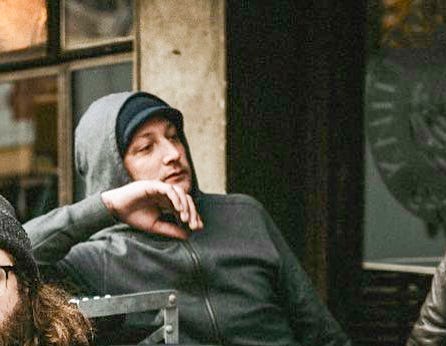
In May 2019, the band went quiet, indefinite hiatus, no promises attached. Augerhole picked up road work with another touring outfit tied to Roger Clyne and The Peacemakers, but he never once treated it as a way out. When Felker went through his own stretch of recovery, Augerhole didn’t wait around wondering. “There’s Evan,” he says. “I’ve known him long enough. He just can’t help himself. He’s going to be a writer.”
They came back in 2021, bigger than they’d left, and the job came back bigger with it, London, Ireland and Jamaica, all the way to a Saturday night in Rogers. A few months back in Minneapolis, Felker decided mid-set he wanted to play Gordon Lightfoot’s “The Wreck of the Edmund Fitzgerald.” It’s a song built entirely out of verses, no chorus to fall back on, one the band had never once rehearsed. Felker turned toward stage right and asked for the words. “That is a really long song, my friend,” Augerhole told him. “No verses, like, it’s just, is what it is.” Felker said he was doing it anyway. “All right,” Augerhole said. “I got you.” He pulled it up behind the box and fed him the lines as they came.
Back home, none of it follows him. Augerhole and Edwards can still be found at Del Rancho in Tahlequah, Oklahoma, eating chicken-fried steak while the lunch crowd walks past without a second glance. In Cherokee County, neither man acts like anything other than regular folk.
Augerhole knows it won’t run forever. “At some point, they’re gonna have to retire,” he says, the same as anything does. What doesn’t end, in his telling, is the rest of it, the friendships that were there before any of this was a job and that’ll still be there in Tahlequah long after the lights go down on Turnpike Troubadours for good.
The house lights will drop soon. The crowd will watch six musicians and never once look toward stage right, where a Cherokee guy from Tahlequah is already hiding behind a little board box, waiting on whatever Felker decides to play.
“I do not regret a single moment,” Augerhole says. “I stuck with this band because they’ve been good to me.”