



According to Keetoowah and Cherokee ceremonial tradition, the sacred fire never went out. It moved with the people.
What’s documented is narrower, and it’s the real story. The archaeological record. Federal trust documents. James Mooney’s ethnographic work, published in 1900. Resolutions from two federally recognized tribal governments. Together they trace a line of ceremonial continuity from a river bend in the Great Smoky Mountains to the stomp grounds of eastern Oklahoma.
The place is called ᎩᏚᏩ. The name comes from a root meaning to gather — the place where gathering happened. It’s one of the seven mother towns of the Cherokee people, sitting in what’s now Swain County, North Carolina, along the upper Tuckasegee River before it meets the Oconaluftee. Archaeologists date the earthwork mound there to roughly A.D. 1000, built by people of the South Appalachian Mississippian culture.
Mooney did his fieldwork among the Cherokee from 1887 to 1890. The Bureau of American Ethnology published it in 1900. He recorded how the mound was built: a circle of stones on the ground, a fire at the center, the bodies of prominent leaders placed near it with objects of spiritual significance. A priest conjured these against disease, protecting the town from any enemy who might destroy it. Women carried in earth by the basketful. At the center they fitted a hollow cedar trunk around the fire, tall enough to reach nearly to the surface once the mound was finished. The townhouse went up on top of that.
“One man, called the fire keeper, stayed always in the townhouse to feed and tend the fire,” Mooney wrote.
Just before the Green Corn dance, every fire in the settlement was put out. People came to the townhouse and carried home new fire lit from the sacred flame. Mooney called it atsi’la galunkw’ti’yu — the honored or sacred fire. “Some say this everlasting fire was only in the larger mounds at Nikwasi, Kitu’hwa, and a few other towns,” he wrote, “and that when the new fire was thus drawn up for the Green-corn dance it was distributed from them to the other settlements.”
Every hearth in the nation connected back to that one center.
Mooney recorded that Cherokee people, on ceremonial occasions, called themselves Ani-Kitu’hwagi — people of Kitu’hwa. He called Kituwah “apparently the original nucleus of the tribe.” The Ani-kitu-hwagi held the northern edge of Cherokee territory, standing between the heartland towns and Iroquois raiders from the north. The name outlasted the position. Keetoowah. Giduwa. Both trace back to that mound on the Tuckasegee.
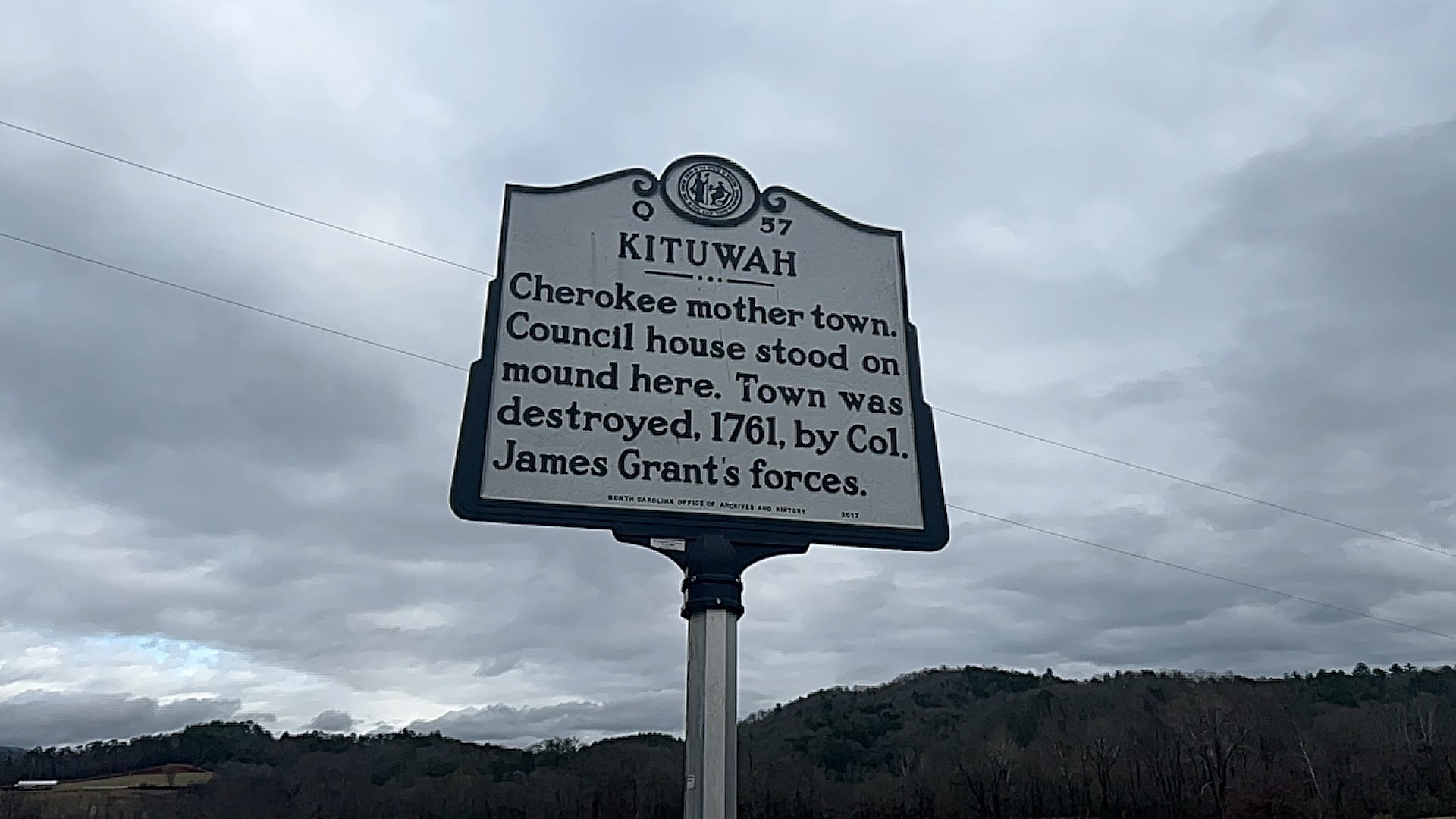
The British burned Kituwah in 1761, during the Anglo-Cherokee War. Survivors scattered west. By 1819 the Cherokee had lost the Kituwah area outright, ceded by treaty under federal pressure. Then came the 1830s, and federal troops removed most of the Cherokee people west on the Trail of Tears. Settlers took the land behind them. They farmed the mound for generations. By the time Cherokee ownership ended, the site sat inside a private tract called Ferguson’s Field. Archaeologists have confirmed the mound was plowed repeatedly.
Cherokee oral tradition, as Mooney recorded it, held something else was happening underneath: “The fire burns yet at the bottom of these great mounds, and when the Cherokee soldiers were camped near Kitu’hwa during the civil war they saw smoke still rising from the mound.”
Out west, in Indian Territory, Cherokee traditionalists who refused to let their culture dissolve formed the Keetoowah Society in 1858. The Keetoowah Society’s own published history says four firecarriers brought the sacred fire west with them when the people were forced off their land — and that no stomp ground can exist without that same fire, physically carried to it. Redbird Smith led a ceremonial revival in the late 19th and early 20th centuries. He located the sacred wampum belts that recorded Cherokee and Keetoowah history and established stomp grounds across eastern Oklahoma, where the fire tradition kept going. Seven ceremonial grounds still operate there today within the Keetoowah tradition, according to the UKB John Hair Cultural Center and Keetoowah Museum in Tahlequah.
Back east, the Eastern Band of Cherokee Indians bought 309 acres on the Tuckasegee River in 1996, mound included. A year later, an archaeological survey turned up thousands of artifacts and identified a 65-acre village site, according to Western Carolina University professor Tom Belt. Surveyors also found 15 confirmed burials. The tribe’s own council resolution puts the real number, if fully excavated, as high as 1,000 or more graves. The Eastern Band left the site undeveloped.
On Oct. 18, 2021, Principal Chief Richard Sneed signed 307.03 acres of the Kituwah site into federal trust for the Eastern Band. The Bureau of Indian Affairs had cleared the way the month before.
“This is an historic day for all Cherokee,” Sneed said just before he signed.
He credited the 1996 purchase to Joyce Dugan, the Eastern Band’s first female principal chief, and said every Cherokee — “Eastern Band, Cherokee Nation, or United Keetoowah Band” — owes her a debt for it.
That same year, at a joint council meeting held at Kituwah, the Eastern Band and the United Keetoowah Band signed a resolution pledging to “forever be keepers of the Keetoowah tradition,” Smoky Mountain News reported. Runners had carried torches to the site, lit from the eternal flame at the Mountainside Theatre in Cherokee, North Carolina — a flame that was itself kindled 55 years earlier from coals carried out of Oklahoma’s ceremonial fire.
The Keetoowah Museum in Tahlequah calls the Keetoowah people the most traditional of the Cherokee, keepers of what it describes as the tribe’s original sacred name. All three federally recognized Cherokee tribes — the Cherokee Nation, the Eastern Band, and the United Keetoowah Band — name Kituwah as the place their people came from.
ᎩᏚᏩ. The place where they gathered. Still gathering.
SOURCES James Mooney, Myths of the Cherokee, Bureau of American Ethnology, 19th Annual Report, Government Printing Office, 1902. https://archive.org/stream/mythsofcherokee00moon/mythsofcherokee00moon_djvu.txt Oklahoma Historical Society, “Redbird Smith” entry (RE015): https://www.okhistory.org/publications/enc/entry?entry=RE015 Keetoowah Society, “Factions”: http://keetoowahsociety.org/factions.htm The Cherokee One Feather, “Kituwah placed in trust for Tribe” (Oct. 20, 2021): https://theonefeather.com/2021/10/20/kituwah-placed-in-trust-for-tribe/ The Cherokee One Feather, “EBCI council designates Kituwah Mound ‘sacred site’” (Dec. 17, 2013): https://www.cherokeephoenix.org/news/ebci-council-designates-kituwah-mound-sacred-site/article_8e827efb-0bab-51a9-9913-c8b9201d4d3e.html Smoky Mountain News, “What is Kituwah?” (Feb. 10, 2010): https://smokymountainnews.com/archives/item/1073-what-is-kituwah Smoky Mountain News, “Anchored at Kituwah: After 138 years, Cherokee will reclaim its mother town as sovereign territory” (Jan. 12, 2022): https://smokymountainnews.com/archives/item/32585-anchored-at-kituwah-after-138-years-cherokee-will-reclaim-its-mother-town-as-sovereign-territory Wikipedia, Kituwa, citing EBCI archaeological surveys and National Register of Historic Places listing 31Sw2 (1973): https://en.wikipedia.org/wiki/Kituwa UKB John Hair Cultural Center and Keetoowah Museum, Tahlequah, Oklahoma. YouTube Talking Circle (Dec. 4, 2023):