


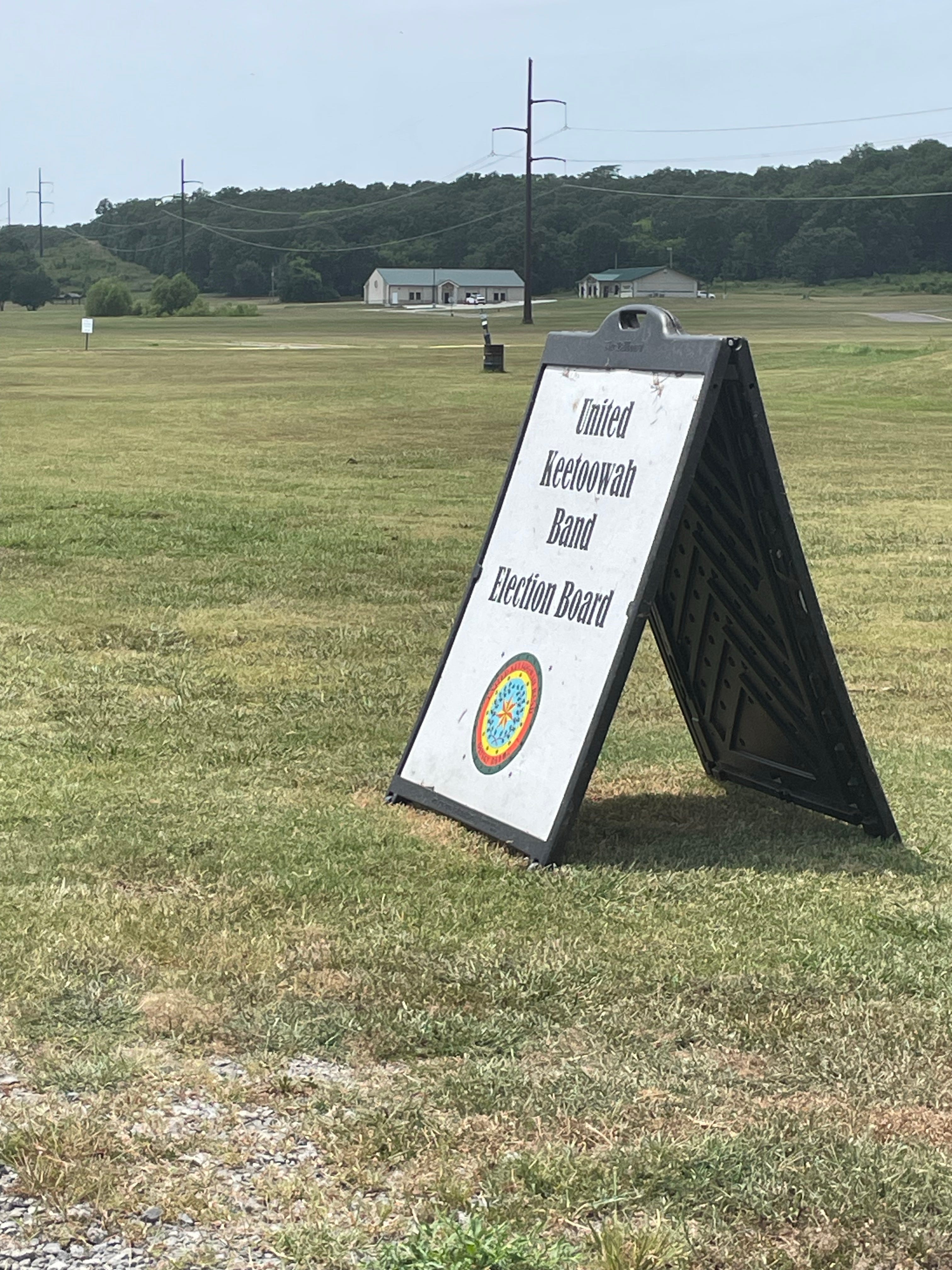
The envelope from J.T. Vann’s law office was postmarked Sept. 8 and reached Troy Littledeer on Sept. 11, the day he sued to get back on the Flint District Tribal Council ballot. Vann is the attorney for the Election Board of the United Keetoowah Band of Cherokee Indians in Oklahoma. The papers inside named Littledeer as a respondent in “Kristie Bradley v. Troy Littledeer and United Keetoowah Band Election Board,” No. 2026-CONTEST-01, a case Littledeer said he had not been told about. The certificate of service carried the printed line “Justin T. Vann/Staff” with no signature above it.
The board had removed Littledeer from the ballot Sept. 8, ruling he did not meet a five-year membership requirement. On Oct. 13, UKB District Judge Charles Tripp dismissed Littledeer’s lawsuit and upheld the board without ruling on what that requirement means. Littledeer has expressed he may file a notice of appeal to the UKB Supreme Court. The UKB regular election is Nov. 2.
WHAT THE LAW SAYS
The UKB Constitution, ratified Oct. 3, 1950, sets the qualifications for council members in its bylaws. A council member must be “not less than twenty-one years of age, a resident of the district he represents and a member of the United Keetoowah Band of Cherokee Indians in Oklahoma.” The constitution does not mention exclusive membership, blood quantum or a five-year period. Article IV gives the council power to “prescribe rules and regulations governing future membership.”
The council adopted the current election ordinance in 2025. Section 501(A)(3)(b) requires a district representative candidate to “be an exclusive member of the United Keetoowah Band of Cherokee Indians in Oklahoma for a period of not less than five (5) years prior to filing.” Section 104(G) defines an exclusive member as a tribal member “who can prove ¼ degree or more of Cherokee Indian blood and is not an enrolled member of any other Tribe/Band.”
Littledeer enrolled in the UKB in 2005. He applied for Cherokee Nation citizenship in October 2012 and relinquished it through a Cherokee Nation District Court order entered Sept. 4, 2024, and amended in March 2025. He filed for the Flint District seat Aug. 14, the last day of the filing period. The 13-member council has nine district representatives and four officers elected at large.
The board’s Sept. 8 decision says Littledeer did not meet the five-year requirement. It gives no dates and no calculation.
Littledeer says Section 501(A)(3)(b) does not expressly state that the five years must be continuous or must end immediately before filing, and that his UKB-only years from 2005 to 2012 should count. He points to other parts of the ordinance where the council spelled out time periods. Section 501(B)(1) bars candidates with a felony conviction “within the past ten (10) years.” Section 403(A) lets an eligible voter vote in the district where that person “has resided for the six (6) months prior to the election,” and a voter who moves during those six months cannot vote in the new district until the next election. Section 203 requires Election Board members to be exclusive members but sets no length of membership.
“The law has to be followed the way it’s written,” Littledeer said in an Oct. 14 interview. “If the council wanted five years in a row right before filing, it knew how to say so. The board can’t enforce a requirement that isn’t in the text and call it interpretation.”
The board reads it differently. In a Sept. 25 court filing, it said the “legislative intent and plain and ordinary reading” of the provision require exclusive membership that is “continuous and direct in time with the filing.” The filing says Littledeer “stipulated that he was a member of the Cherokee Nation tribe within the last couple of years.”
Littledeer’s petition asks the court to determine under Section 715 of the UKB Courts Act whether Section 501(A)(3) of the ordinance, “in whole or in part, or the Board’s interpretation and application of it, is authorized by the Constitution and tribal law.” Before taking office, each Election Board member swears under Section 205 of the ordinance to “support, protect, and defend the Constitution and By-laws” of the UKB and to conduct elections “fairly, impartially, and in accordance with the laws” of the band. “The constitution says a council member has to be a member of the band,” Littledeer said. “It doesn’t say exclusive member, and it doesn’t say five years.”
THE DEADLINE
Section 508 requires a challenge to a candidate to be filed “within three (3) business days of the closing of the filing period.” Filing closed Aug. 14, putting the deadline at Aug. 19. On Aug. 17, the board announced it was moving the deadline to Aug. 20. It gave Littledeer until 5 p.m. that day to answer the challenge filed by Kristie Bradley, the UKB tribal court administrator.
Littledeer said he asked the board Sept. 4 when it received Bradley’s challenge and has not received an answer. The board’s Sept. 25 filing does not cite authority for the extension. It argues Littledeer did not raise the issue at his Sept. 2 hearing. But Littledeer’s emails to the Election Board chair woman Wyanetta Springwater show he did ask.
THE HEARING
The board’s hearing notice, signed by Chairwoman Springwater, said the board would “stand as a neutral participant only” and that it “has an obligation to investigate any candidate’s qualifications on its own accord.” At the Sept. 2 hearing at the John Hair Cultural Center in Tahlequah, Littledeer said, Bradley’s challenge took about 15 minutes before she was dismissed from the room. Vann then questioned Littledeer for about an hour and 35 minutes, he said.
WHO MAY BRING A CHALLENGE
Section 508 allows “any candidate or eligible voter” to challenge a candidate. Under Section 401(A)(2), an eligible voter must have been an exclusive member for at least six months before the election, which under Section 104(G) means proving one-quarter degree or more of Cherokee Indian blood and not being enrolled in another tribe.
The board’s Sept. 8 decision does not say whether the board determined that Bradley met those requirements before it accepted her challenge. Littledeer said he raised the question in a Sept. 3 email to Vann. Bradley’s name appears on a June 2 Flint District voter list filed as an exhibit in the case. The court reporter’s transcript shows the question was asked but interrupted by the court reporter and never resolved. Littledeer said he is not alleging that Bradley is ineligible.
“They held me to a requirement the law doesn’t state, and nobody has shown me that they checked the person who challenged me against the requirements the law does state,” Littledeer said. “Before you remove a candidate, you have to know the challenge was brought by someone the law allows to bring it.”
SOURCES
UKB Constitution, Article IV, Article V and Bylaws, Article II, Section 3. UKB 2025 Election Ordinance, Sections 104(G), 401, 501(A)(3)(b), 501(B)(1), 503 and 508. Election Board Notice of Hearing, signed by Chairwoman Wyanetta Springwater. Petitioner’s Amended Complaint and Exhibits, CV-2026-04, UKB District Court, including Exhibit R. Notice of Newly Received Evidence and Exhibits X-Z, CV-2026-04. Respondent Election Board’s Response and Motion to Strike and Motion to Dismiss, Sept. 25, 2026. Decision on Election Board Challenge, filed Oct. 13, 2026. Littledeer email to J.T. Vann, Sept. 3, 2026. UKB Tribal Enrollment Card. Cherokee Nation Application for Citizenship, Oct. 22, 2012. Cherokee Nation District Court Order of Relinquishment, CV-2024-722, Sept. 4, 2024, and amended order, March 2025. Littledeer interview, Oct. 14, 2026. Littledeer’s account of the Sept. 2 hearing.