

TAHLEQUAH, Okla. — Hannah Cole’s signs were gone.
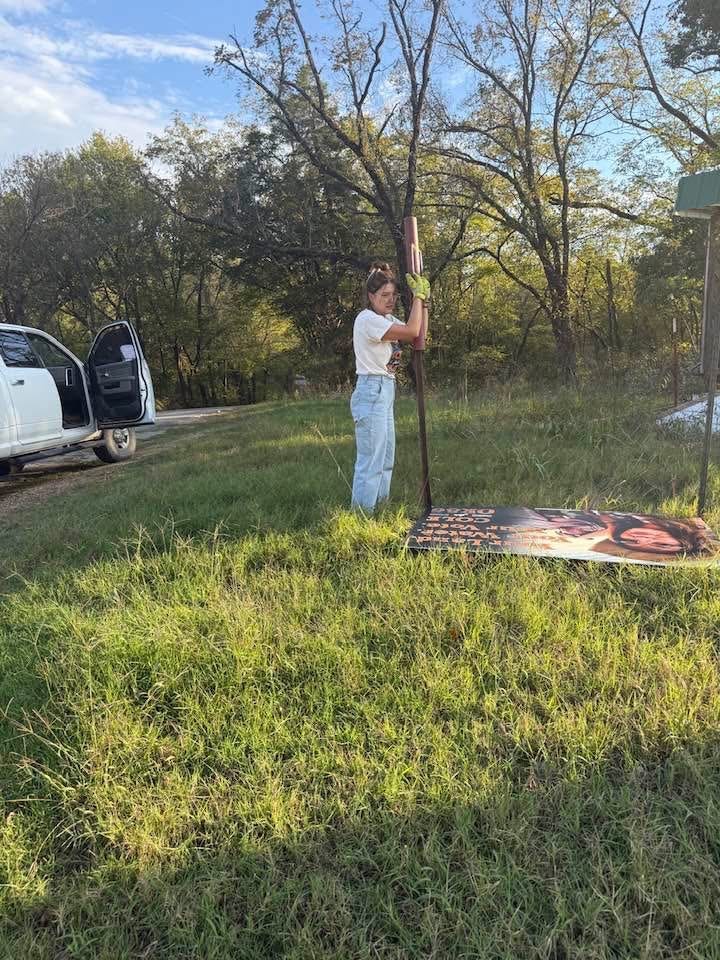
The Democratic candidate for Oklahoma House District 86 got word the night of Oct. 23 that campaign signs she’d placed along State Highway 10 had been taken down. The next day she drove the highway and documented every spot where a sign had stood and which ones were missing.
“That was money that my supporters so graciously donated,” Cole wrote in an Oct. 30 email. “They bought those signs.”
Many of those supporters gave $5 or $10, according to Anne “Missy” Fite, a Cole supporter who was the Democratic nominee for the same seat in 2024. Some of them, Fite told a state highway superintendent on Oct. 30, “can barely afford to eat.”
Cole is a nurse and a Cherokee Nation citizen. Her district takes in Adair County and parts of Cherokee, Delaware and Mayes counties, all within the Cherokee Nation Reservation, where more than 4 in 10 Adair County residents are American Indian. Her opponent, state Rep. David Hardin, a Republican from Stilwell and fellow Cherokee Nation citizen, has held the seat since 2018. His campaign biography says he spent almost 40 years in law enforcement.
Records released by the Oklahoma Department of Transportation show the order to remove one of Cole’s signs came Oct. 22, 33 minutes after a text message asking whether the land beneath it belonged to the state.
THE ORDER
Derrick Ross of Stilwell asked ODOT for the records Oct. 27 under the Oklahoma Open Records Act. The agency produced screenshots of text messages within about a day, and Ross provided them for this story.
The screenshots don’t identify the official whose phone they came from. Tahlequah office staff told Cole the complaint came from Muskogee, where ODOT’s district headquarters oversees eight eastern Oklahoma counties, Cherokee County among them.
At 12:51 p.m. Oct. 22, a contact saved in the official’s phone as “David” wrote: “Good afternoon is the SE corner of chewy RD and HWY 10. State Property.”
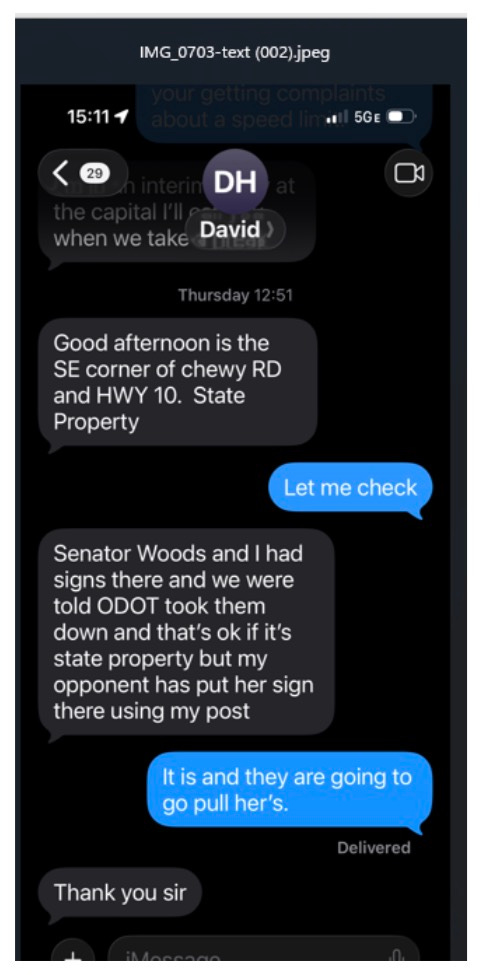
“Let me check,” the official replied.
The contact explained why he was asking. “Senator Woods and I had signs there and we were told ODOT took them down and that’s ok if it’s state property but my opponent has put her sign there using my post.”
The reference appears to be to state Sen. Tom Woods, a Westville Republican whose district includes part of Cherokee County. The messages don’t show Woods taking part in the exchange or contacting ODOT.
A minute later, the official passed the question to a co-worker saved as “Darren.” Darren answered with a phone photograph of a computer monitor. On the screen was an aerial map of the intersection, with a parcel labeled “STATE OF OKLA.” Under it, Darren wrote, “Yes sir.”
The official went back to the “David” contact: “It is and they are going to go pull her’s.”
At 1:24 p.m., the official texted Beau Ballard, superintendent of ODOT’s Cherokee County maintenance office in Tahlequah: “Need you to please go pull at campaign sign at SH-10 and Chewy Rd. We pulled two recently and their opponent put up her signs on their posts.”
Ballard answered, “Ok.” More than two hours later, at 3:35 p.m., the official wrote back, “Thanks.” Screenshots from both phones show the same exchange.
The records don’t say when crews pulled Cole’s sign, or when or why the two earlier signs came down.
THE CONTACT
On the official’s phone, the contact shows up as “David,” beside a round icon bearing the initials “DH.” iPhones build those initials from the name saved for a contact, or show initials the sender has chosen to share. ODOT hasn’t said who the contact is.
There’s no phone number for “David” in the screenshots. Above the Oct. 22 messages sits an older text from the contact, mostly hidden under the screen header, with the words “interim,” “at the capital” and “when we take” still legible. It shows the contact and the official had been in touch before. Nothing in the records independently establishes who sent the messages, and ODOT hasn’t identified the official whose phone held them.
Cole said she believes the contact was Hardin. Hardin didn’t respond by a 3 p.m. Oct. 30 deadline to emailed questions asking whether he took part in the exchange or contacted ODOT about Cole’s signs.
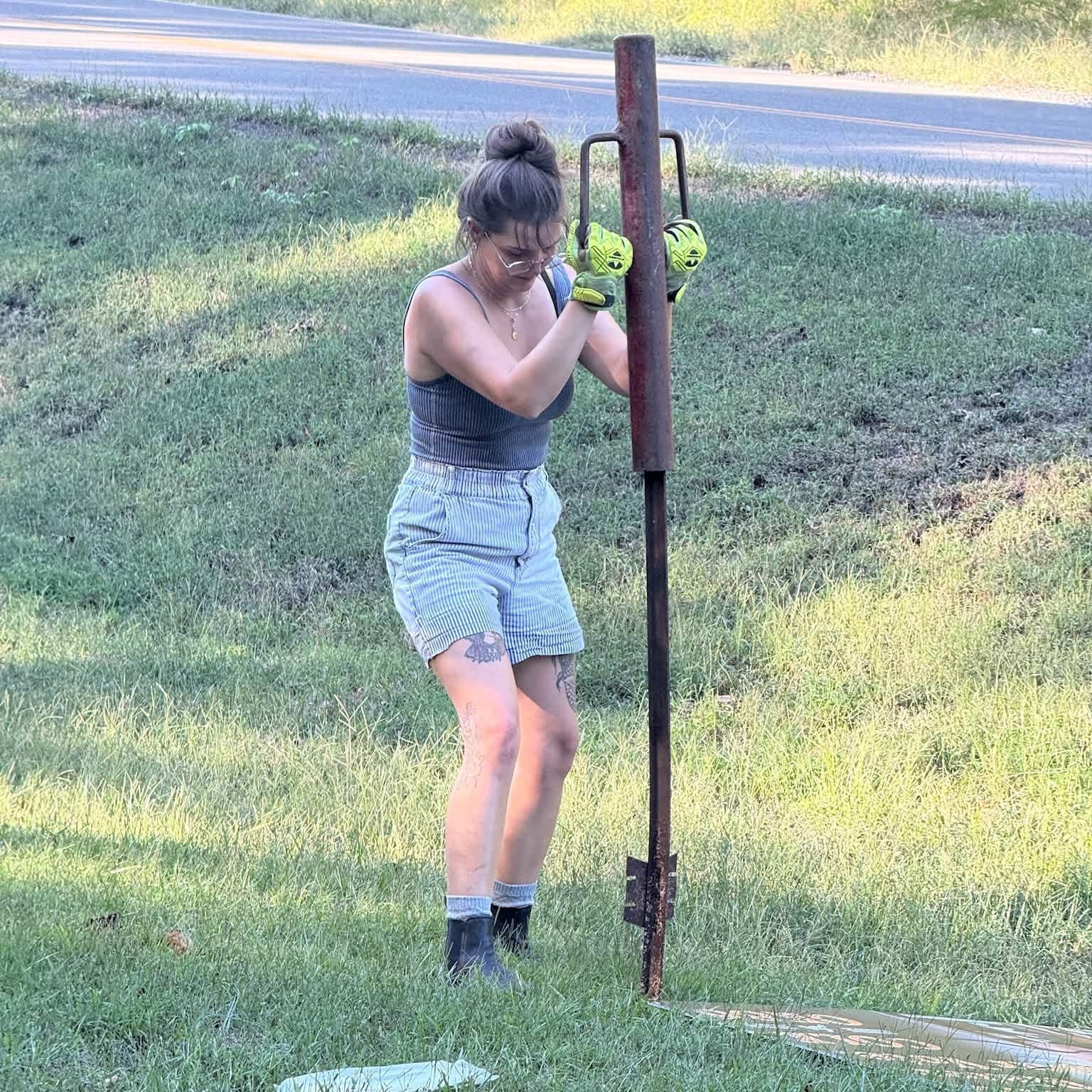
Cole denied using anyone else’s posts. “I’ve got the picture of me driving my own t-post at the location he claimed I used his at,” she wrote in the same email, referring to Hardin.
THE OFFICE
Cole went to ODOT’s Tahlequah office Oct. 26 to pick up her signs. She said employees told her the complaint had come from Muskogee and the order went straight to the Tahlequah superintendent.
On Oct. 30, she learned more of her signs were gone. She went back to the office with Fite, and this time she recorded the conversation.
“I recorded video because I felt as though this whole situation was fishy,” Cole said. “I recorded them because I also did not want a he said she said scenario after I made this info public.”
On the video, Ballard explained how a single complaint travels. “When we get one complaint, we try to cover the whole county,” he said. “So we pick up campaign signs, political signs, the signs of the stores and stuff.”
Crews had worked Highway 10 earlier that week, he said, then highways 62, 82 and 100. He didn’t say which complaint, if any, started that work. Sign complaints come with every election, Ballard said, and the sweeps give crews a chance to clear real estate and business signs they usually don’t have time for. The Oct. 22 instruction, by contrast, named one campaign sign at one intersection.
“What they don’t realize is, we’re not just picking up your signs,” Ballard said.
Brett Smith, who works at the Tahlequah office, said crews had left two of Cole’s signs standing, one of them “kind of borderline, but it is on right of way.”
Ballard offered to meet Cole out on the highway and show her where the right of way runs. On rural roads, he said, the fence line usually marks it.
Later in the same conversation, Fite showed Ballard a tree where crews had pulled a sign. She said the tree stood outside the right of way, on her own property.
“I’m gonna apologize to you,” Ballard told them.
Ballard told Cole he wasn’t sure who removed Hardin’s signs the week before, only that it wasn’t his crew and that he was repeating what he’d been told. He said he thought the location was “Chewey.” Asked whether ODOT had removed Hardin’s signs, he said, “Yes, ODOT did remove them, but it wasn’t my crew.” It might have been one of his bosses, he said, but he didn’t know. Someone higher in the agency had removed the signs the week before and then saw Cole’s sign in the same spot, Ballard said, and he thought that was where the complaint came from.
THE CALL
Smith described a second complaint, about signs at a place Cole called Riverbend. Crews took those down the morning of Oct. 28, the first day of early voting. Before that, Smith said, a call came to his phone from someone who’d seen a social media post by Cole and worried she’d put pulled signs back up. Crews had left those two signs standing because they weren’t sure where the boundary ran, Smith said.
Cole asked whether the call came to his work phone.
“That was my personal phone,” Smith said. He said the number wasn’t in his contacts and he didn’t know who called, and he declined to give Cole the number because it was on his personal phone.
Oklahoma Attorney General Opinion 2009 OK AG 12 says electronic communications about public business don’t become exempt from disclosure because employees use privately owned devices. The opinion doesn’t address whether an employee’s personal call log, or other record of an unrecorded voice call, is a public record.
THE LINE
ODOT has reminded candidates every election season for at least a decade that campaign signs don’t belong in highway rights of way. Its April 2 reminder this year said rural rights of way generally include the grassy area between the highway and the nearby fence.
State law, 69 O.S. §§ 1208-1209, prohibits signs and certain other structures on or overhanging highway rights of way and authorizes their removal. The law reaches signs within or overhanging the legally established right of way, not every piece of land the state owns.
The photo in the Oct. 22 texts shows a parcel labeled “STATE OF OKLA.” It doesn’t mark where the right of way ends at the southeast corner of Highway 10 and Chewey Road.
An Oct. 29 open-records request filed for this story asked ODOT for the right-of-way maps, surveys, plans and property records for that corner. Written questions sent with it asked who authorized the removals, who carried them out and how complaints are received. ODOT hadn’t responded as of Oct. 31. The agency hasn’t said how many signs its crews removed across Cherokee County or whose signs they were, and the records released so far don’t show whether complaints from candidates or elected officials go through the same process as complaints from the public.
The general election is Nov. 3.
SOURCES
Primary records
• Oklahoma Department of Transportation, text-message screenshots of the Oct. 22, 2026, exchanges (the “David,” “Darren” and “Beau” threads, plus the screenshot from Ballard’s phone), produced under Open Records Request No. 26-0752 and provided by Derrick Ross
• Oklahoma Department of Transportation, Open Records Request No. 26-0752 intake, submitted by Derrick Ross, Oct. 27, 2026
• Troy Littledeer, Open Records Act request and questions to ODOT, Oct. 29, 2026
• Troy Littledeer, emails to Rep. David Hardin, 5:54 a.m. Oct. 29 and 3:46 p.m. Oct. 30, 2026
Recording and correspondence
• Hannah Cole, video recording at the ODOT maintenance office in Tahlequah, Oct. 30, 2026, with Beau Ballard, Brett Smith and Anne “Missy” Fite
• Hannah Cole, email to Troy Littledeer, Oct. 30, 2026
Law
• 69 O.S. §§ 1208-1209
• Oklahoma Senate Bill 1771 (2024), amending 69 O.S. § 1208: https://www.oklegislature.gov/cf_pdf/2023-24%20ENR/SB/SB1771%20ENR.PDF
• Oklahoma Attorney General Opinion 2009 OK AG 12
• Hogner v. State, 2021 OK CR 4 (Cherokee Nation Reservation): https://www.okbar.org/wp-content/uploads/2021/03/2021-OK-CR-4-1.pdf
Government publications
• ODOT, PR# 26-012, April 2, 2026: https://oklahoma.gov/odot/about-us/newsroom/2026/reminder-from-odot--campaign--advertisement-signs-are-not-allowe.html
• ODOT, PR# 20-014, June 12, 2020: https://oklahoma.gov/odot/about-us/newsroom/2020/june/odot-reminds-candidates-that-campaign-signs-don-t-belong-alongh.html
• ODOT, PR# 16-008, Feb. 22, 2016: https://oklahoma.gov/odot/about-us/newsroom/2016/february/campaigns-reminded-to-keep-political-signs-out-of-highwayrights.html
• U.S. Census Bureau, QuickFacts, Adair County, Oklahoma: https://census.gov/quickfacts/fact/table/adaircountyoklahoma/PST045224
• Oklahoma House of Representatives, district listing, 60th Legislature: https://members.okhouse.gov/Documents/Districts/60th%20Legislature%20HD.pdf
• Oklahoma State Election Board, 2026 general election calendar
Biographical sources
• Native Oklahoma, “In House District 86, Democrat Hannah Cole challenges Hardin on the distance between home and a doctor”: https://www.nativeoklahoma.us/in-house-district-86-democrat-hannah-cole-challenges-hardin-on-the-distance-between-home-and-a-doctor/
• David Hardin campaign biography, as reposted in the CAIR Oklahoma candidate guide: https://www.cairoklahoma.com/candidates/david-hardin/
• Wikipedia, “David Hardin,” citing Indian Country Today, “A glance at Indigenous state lawmakers,” March 3, 2022: https://en.wikipedia.org/wiki/David_Hardin
• Ballotpedia, “Anne Fite”: https://ballotpedia.org/Anne_Fite