


On July 13, 32 people who worked for the United Keetoowah Band of Cherokee Indians in Oklahoma sat in a room in Tahlequah, Okla., waiting to find out if they still had jobs. Their pay came from federal American Rescue Plan Act money, and that money had run out. Donald Adair, who represented the Sequoyah District on the Tribal Council, stood up and told them, “I’m sorry. The council failed you.” One worker told me that week, “We were basically getting laid off, and I didn’t get any answers.” Two days later, Human Resources Director Michelle Downing told the Council six of those 32 workers still didn’t have anywhere to go.
Adair had been asking questions before that. I was at the June 6 Council meeting when he read questions from tribal members about who approves the tribal secretary’s travel and how much it costs. Chief Jeff Wacoche cut him off. “You just gotta read your emails, sir,” he said. Nobody gave a number that day. I haven’t seen one since.
Then came July 13. Adair filed a sworn petition in Cherokee County District Court that same day. He said in the petition that Wacoche cussed him in front of the workers, threatened to beat him and told him to come outside. Four people who were in that room have since told me what they saw, and their accounts back up Adair’s. Witnesses also told me Lighthorse officers walked the chief out. I asked Wacoche for comment July 14. He didn’t answer.
On July 23, Judge Jerry S. Moore turned down Wacoche’s request to throw the case out, heard testimony and held off on ruling. KOSU has since reported nothing came of the case. Wacoche has a different account of what happened. KOSU reported that at an Oct. 23 Council meeting, he said Adair was the one who came at him and offered to release video. That video hasn’t been made public, KOSU reported, and Adair denies the chief’s version.
What happened to Adair after that involves rules that have been in place for decades. The tribe’s 1950 Constitution sets up the Council with nine district representatives and four officers elected by the whole tribe. That’s 13 seats. District representatives have to live in the districts they represent. The boundaries come from a map the Council approved in 2005, and the tribe’s Supreme Court ruled in 2024 that the 2005 map determines where people live for district purposes. Wacoche didn’t come up with that requirement for this fight. He quoted the same rule in a June 7, 2025 speech to the Council.
Then there’s the Impeachment Code. It lays out how an elected official can be charged with wrongdoing and removed from office. Under the 2005 version, charges “may be brought by any elected official of the United Keetoowah Band.” If the chief is charged, the assistant chief calls the hearing and runs it. The chief doesn’t sit on the panel. The code also says a meeting must be held within 30 days “specifically to hear” the charges. I read all eight pages. I couldn’t find anything that lets someone throw out the charges before that hearing.
Adair filed impeachment charges against Wacoche on Oct. 16. A hearing was set for Nov. 13. Wacoche then took two questions to the tribe’s attorney general, Klint Cowan. Were the Sequoyah and Illinois District seats vacant because Adair and Illinois District Rep. Janelle Adair didn’t live in their districts? And did charges filed by a Council member who didn’t live in his district still count?
Cowan answered in a written legal opinion, No. 2026-03, dated Oct. 23. The first page says Wacoche “recently requested” the opinion. Cowan said both seats were vacant and the charges were invalid and “should be dismissed.” That addressed who filed the charges. It didn’t address whether the accusations were true. Cowan didn’t weigh evidence, there was no hearing, and nobody cleared the chief of the allegations Adair made.
The Council met that same day. Wacoche was listed on the agenda to call the meeting to order. The Council declared both Adair seats vacant, dismissed the charges against the chief and directed the tribal secretary to cancel the Nov. 13 hearing. I don’t think the man facing the charges should be the one calling a meeting where those charges are thrown out.
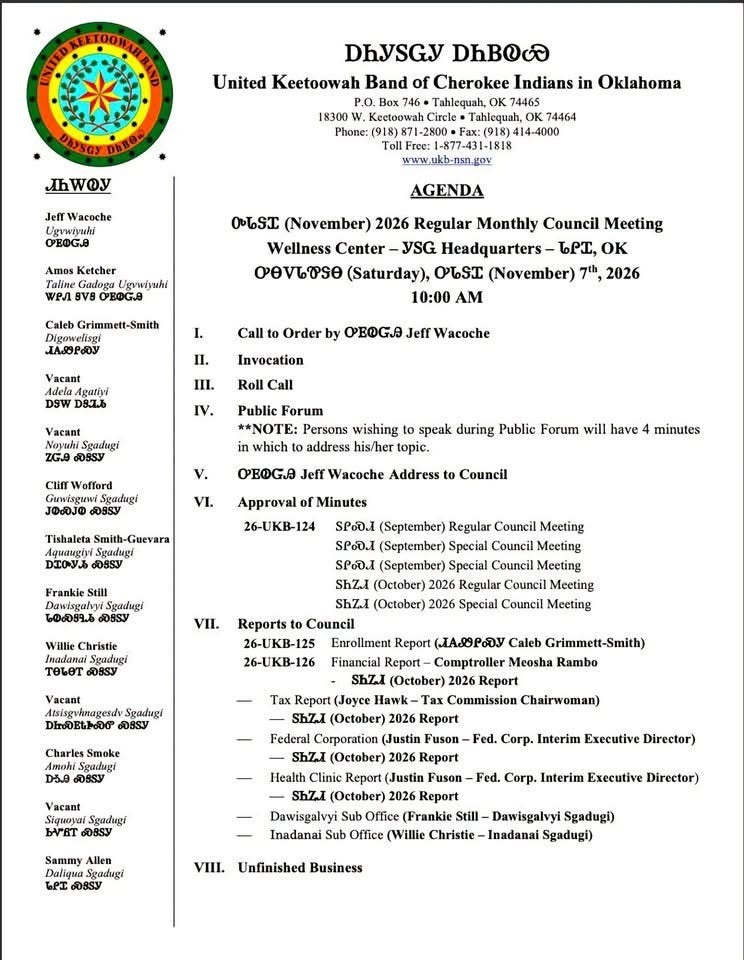
Look at the wording in the code. It says “any elected official.” It doesn’t say “only.” Cowan’s opinion says charges “can only be filed by an elected official,” then quotes the code, which doesn’t include that word. By the time the matter reached the Council agenda, “only” was there. The same agenda lists the Council roster down the left side, with Janelle Adair and Donald Adair listed alongside everyone else.
You gotta give Cowan this much. His opinion gives the Adairs more consideration than the Council agenda did. He wrote that nothing in it “should be interpreted to mean that the subject Council members did anything wrong.” He said they had trusted the 2024 Election Board, which was supposed to check where candidates lived but didn’t catch the issue. He also acknowledged that their argument that they never moved out of their districts “has real force as a matter of language.” Then he relied on a different rule requiring members to live in their districts.
Cowan also told the Council to give both Adairs “written notice” and “a meaningful opportunity to be heard prior to any vote,” citing the federal Indian Civil Rights Act. His opinion is dated the same day the Council voted. There’s nothing on the agenda showing either Adair received notice or an opportunity to speak before the vote.
The Council has a side to this, too. Cowan wrote that the charges “could, of course, be filed again by a lawful elected official.” The accusations against Wacoche could still be brought back. The tribe’s Justice Department Act says the attorney general’s official opinions “shall be followed by other departments” until they’re withdrawn or overturned.
Cowan also wrote that every Council vote the Adairs participated in still counts. That means Donald Adair’s Aug. 14 vote on impeachment charges against then-Treasurer Sonja Gourd stands, even though his own charges against the chief were dismissed.
On Nov. 7, two weeks after the Council meeting, Wacoche gave the Council a speech about money. He said the Election Board had spent $96,753.35. Of that, $71,400 went to stipends, the set payments board members receive, $20,000 went to legal services, and about $5,353 was left to actually run the election.
“Every dollar appropriated by this Council belongs to the tribe,” he said. He wanted the Council to hold back any more Board money until it received a full accounting. He also wanted spending subject to “the same financial controls expected of every other tribal department and entity.”
“This is not about politics, personality or disagreements between branches of government. It is about stewardship,” he said. Anybody who didn’t understand stewardship, he added, should “take the dictionary out and read that.”
Here’s what was happening between the Council and the Board. The Oct. 23 agenda called the Election Board “a subordinate body of the Tribal Council,” meaning it answers to the Council. That same agenda authorized the attorney general to sue the Board and its members.
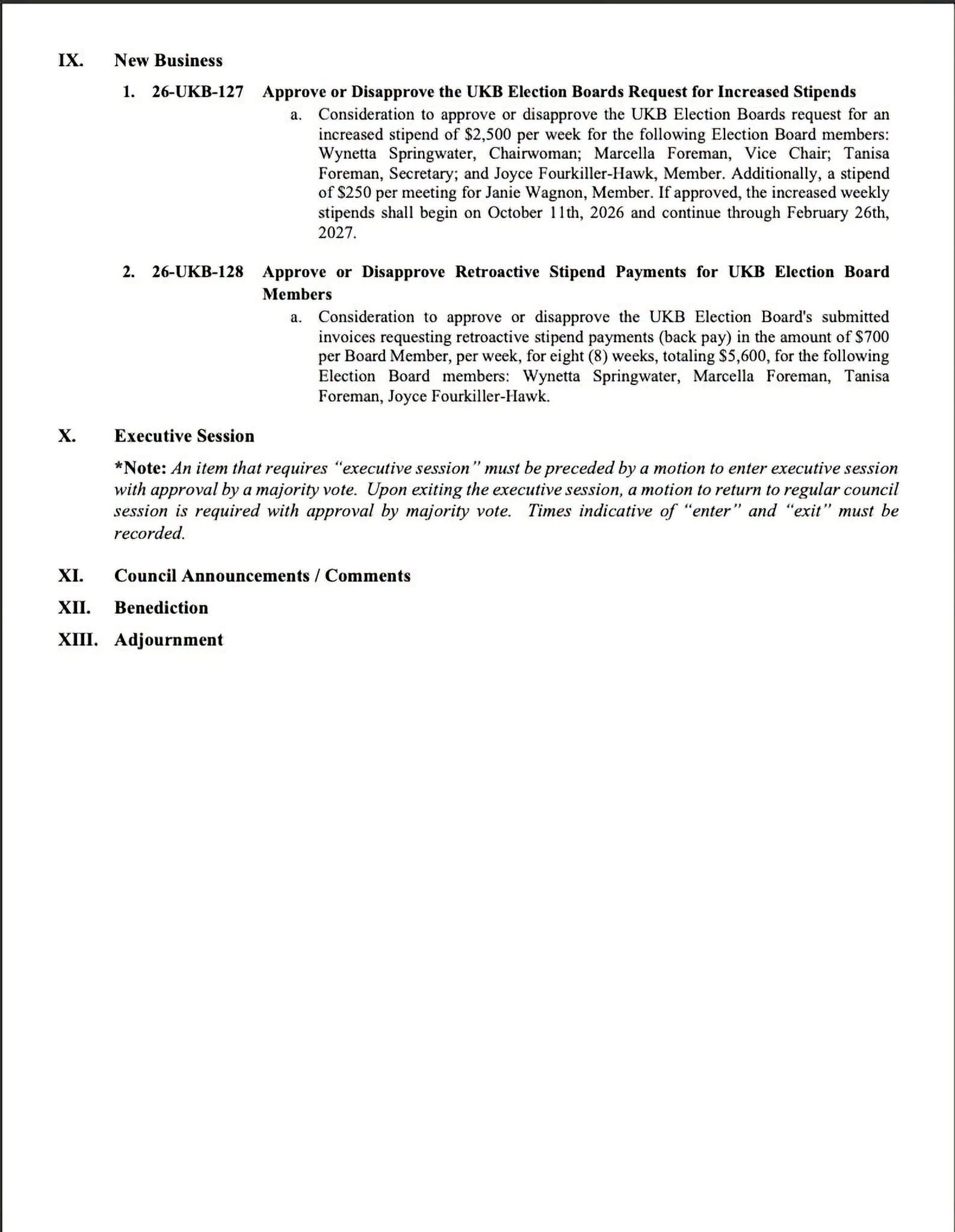
On Nov. 7, the Board asked for $2,500 a week, plus back pay of $700 per member per week for eight weeks. Board Chairwoman Wyanetta Springwater said the $2,500 was supposed to cover election expenses along with the stipends. She said members hadn’t been paid since Sept. 30 and had been buying supplies, a sign and their own gas out of pocket. About $34,000 in bills for ballots, the ballot machine and poll workers were still unpaid, she said. A Dec. 7 runoff was coming, and the Board had no money to run it.
Board member Joyce Hawk, who also chairs the tribe’s Tax Commission, said some of the money owed included $20,000 in legal fees and a $5,000 retainer for future legal action. Nobody made a motion on either request. Both died without a vote.
The Board has questions to answer, too. Tribal Secretary Caleb Grimmett-Smith said the Election Ordinance requires the Board to give the Council a monthly expense report during election season, and the Council hadn’t received one. Springwater said this was her first year as chairwoman. Grimmett-Smith also said the Council budgeted $90,000 for the election, while Wacoche’s own speech put spending at $96,753.35. And the tribe hasn’t had a treasurer since Gourd’s resignation was accepted Aug. 14.
The Oct. 23 agenda also shows the Canadian District seat vacant since Eddie Sacks died. Remove both Adair seats and the Council is down to nine members, even though the Constitution calls for 13. It takes seven to do business. Families in the Canadian, Illinois and Sequoyah districts have nobody representing them when the Council votes on the money and programs they depend on, including the jobs those 32 workers came to ask about.
In the Tahlequah District, the Tahlequah Daily Press reported that incumbent Sammy Allen finished first Nov. 2 but didn’t get more than half the votes. That means a Dec. 7 runoff against Ed McLemore, a second election between the top two candidates. That’s the same election the Board says it doesn’t have the money to run.
Nov. 13 came and went without an impeachment hearing. Cowan’s opinion lists Timothy Pigeon as the only Sequoyah candidate on the Nov. 2 ballot. The Council has since posted openings for treasurer and the Illinois District seat. Letters of interest are due Nov. 27, with a public forum for the Illinois seat scheduled for Dec. 1 and one for treasurer on Dec. 3.
SOURCES
UKB Council meeting, June 6, 2026, attended by the author. Interviews with four people present at the July 13, 2026 meeting. Cherokee County District Court, Adair v. Wacoche, Case No. PO-2026-119, petition and docket. UKB Council meeting, July 15, 2026. KOSU, report on the Oct. 23, 2026 special Council meeting. Wacoche address to Tribal Council, June 7, 2025. Wacoche address to Tribal Council, Nov. 7, 2026. UKB Council meeting, Nov. 7, 2026. UKB Attorney General Opinion No. 2026-03, Oct. 23, 2026. UKB Special Council Meeting agenda, Oct. 23, 2026. UKB Constitution, Art. V. By-Laws, Art. II, Sec. 3. UKB Impeachment Code (2005), Res. 05-UKB-117, Secs. 4, 6. Council Resolution 05-UKB-146 (district map). Buzzard v. United Keetoowah Band, No. AP-2023-01 (UKB S. Ct. 2024). UKB Tribal Justice Department Act, Sec. 9(a). Tahlequah Daily Press, Nov. 2026 election results. UKB Council vacancy notices, Treasurer and Illinois District Representative.