


Native Americans charged with minor crimes on another tribe’s reservation in eastern Oklahoma could keep facing state prosecution, depending on how a federal appeals court rules in a case it heard Nov. 17.
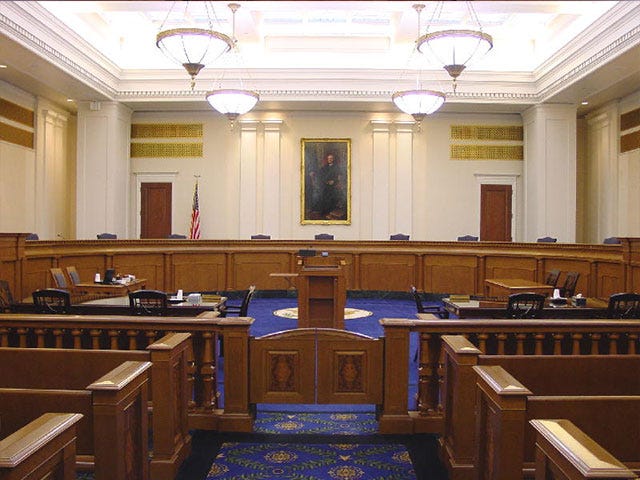
A three-judge panel of the 10th U.S. Circuit Court of Appeals heard Muscogee (Creek) Nation v. Kunzweiler in Denver. Tulsa County District Attorney Steve Kunzweiler says the state can prosecute Native Americans who aren’t Muscogee citizens for crimes on the Muscogee Reservation that fall outside the federal Major Crimes Act. Federal courts call those defendants “nonmember Indians.”
That means anyone who’s a citizen or member of a federally recognized tribe and is on another tribe’s reservation. A Cherokee Nation citizen on the Muscogee Reservation in Tulsa is one. So is a Muscogee citizen in Tahlequah, or a Choctaw citizen in Claremore.
The Muscogee Nation is appealing U.S. District Judge Gregory Frizzell’s Nov. 7, 2025, order denying its request for a preliminary injunction to stop those prosecutions. In that order, Frizzell wrote that Kunzweiler’s office had been prosecuting nonmember Indians on the reservation for more than two years before the Nation sued. The appeal is over that preliminary ruling, and the case itself hasn’t reached a final judgment.
Arguments before the panel
Judges Carolyn McHugh and Harris Hartz and Senior Judge David Ebel heard the arguments. Riyaz Kanji argued for the Muscogee Nation. He pointed to a 1991 federal law that recognized tribes’ power to prosecute all Indians, not only their own citizens.
Kannon Shanmugam argued for Kunzweiler and cited the U.S. Supreme Court’s 2022 decision in Oklahoma v. Castro-Huerta. He told the court nonmember Indians aren’t political constituents of a tribe, since they don’t vote in its elections or use certain of its services.
Ebel asked whether the law has an accepted definition of “Indian,” according to accounts of the hearing from KOSU and Mvskoke Media. Shanmugam said he didn’t know of one. Kanji described a two-part test, some degree of Indian blood and recognition by a tribe.
Beyond Tulsa County
The case reaches past Tulsa County. Two related federal lawsuits are on hold until the 10th Circuit rules.
One challenges prosecutions by Matt Ballard, district attorney for Craig, Mayes and Rogers counties, of members of the Navajo, Chickasaw and Choctaw nations on the Cherokee Reservation. The other challenges prosecutions by Carol Iski, district attorney for Okmulgee and McIntosh counties, of Cherokee and Choctaw citizens on the Muscogee Reservation. The U.S. Justice Department and several tribes are plaintiffs in both, and KOSU reported that Ballard is also working on Kunzweiler’s case.
Tribes already claim criminal authority over nonmember Indians on their reservations. Cherokee Nation’s criminal code, for one, defines “Indian” to include citizens or members of any other federally recognized tribe. If Kunzweiler wins, the state could claim authority to prosecute the same person for the same conduct.
Kanji told the court overlapping prosecutions can run into each other. His example was a defendant ordered into a tribal substance abuse program who could be jailed by the state before finishing the tribal sentence.
Members of the United Keetoowah Band of Cherokee Indians in Oklahoma who aren’t also Cherokee Nation citizens are nonmember Indians on the Cherokee Nation Reservation, where the band has its headquarters. Under the band’s 1990 membership ordinance, a member who enrolls in any other tribe forfeits UKB membership. UKB and Bureau of Indian Affairs records refer to “exclusive” UKB members, though, and the BIA record also counts “non-exclusive” members.
The 2024 ruling behind the case
Kunzweiler’s position builds on City of Tulsa v. O’Brien. In that Dec. 5, 2024, decision, the Oklahoma Court of Criminal Appeals allowed Tulsa to prosecute an Osage citizen for DUI and other misdemeanor traffic offenses on a city street inside the Muscogee Reservation. The city later dropped the case and referred it to the Muscogee Nation.
Under Osage Nation v. Irby, a 2010 10th Circuit decision, the Osage Nation has no recognized reservation. It’s asking the court to reopen that ruling in Osage Nation v. Taylor, which a separate panel of the same court heard Nov. 17.
The Cherokee, Chickasaw and Choctaw nations filed a joint brief backing the Muscogee Nation. So did the United South and Eastern Tribes Sovereignty Protection Fund.
In October, the Legislature’s Joint Committee on State-Tribal Relations voted 6-1 to put $500,000 toward Kunzweiler’s case from the State-Tribal Litigation Fund, which was created with $10 million. Sen. Mary Boren, D-Norman, cast the only vote against it.
KOSU reported that Kunzweiler said in October that if the ruling goes against the state, “we’ll be appealing it up to the Supreme Court.”
The 10th Circuit hasn’t said when it’ll rule.
Troy Littledeer is a Keetoowah Cherokee writer, photojournalist, with more than 20 years in Indigenous media. He received the Indigenous Journalists Association’s 2025 Tim Giago Free Press Award for defending press freedom. His work has appeared in The Times, Native News Online, Osage News, the Cherokee One Feather and the Tahlequah Daily Press. He previously served as media director for the United Keetoowah Band of Cherokee Indians in Oklahoma and PR coordinator for the Cherokee Nation. He lives and works on the Oklahoma Cherokee Reservation.