

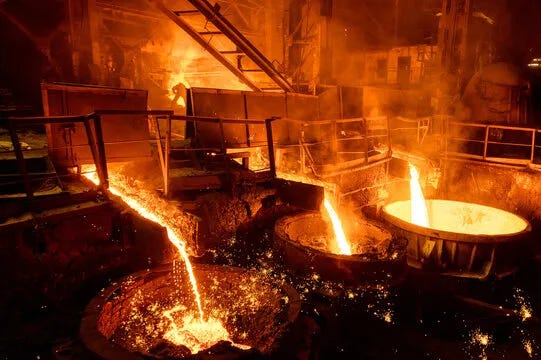
INOLA, Okla. — Oklahoma Attorney General Gentner Drummond asked a federal judge Tuesday to stop construction of a proposed aluminum smelter near Inola, a small town in Rogers County about 25 miles east of Tulsa. A smelter is an industrial plant that melts raw material — in this case, aluminum ore — at extremely high temperatures to turn it into usable metal, a process that burns large amounts of energy and can release pollutants into the air.
Drummond’s motion, filed in U.S. District Court for the Northern District of Oklahoma, states the proposed facility would sit on 633 acres along the Verdigris River. That’s more than double what Drummond’s original petition said in June, when he filed suit in Rogers County District Court and described the same project as covering about 350 acres. The new filing doesn’t explain the 283-acre gap between the two numbers.
Drummond first sued in Rogers County District Court in June to try to block the project. Attorneys for Century Aluminum Co. moved the case to federal court in July, and Drummond’s Tuesday motion asks the federal judge to send it back to Rogers County, where it started.
The proposed plant, called Oklahoma Primary Aluminum, is a joint venture between Emirates Global Aluminium, a state-owned aluminum producer controlled by the government of the United Arab Emirates, and Century Aluminum Co., a publicly traded American company based in Chicago — with EGA holding 60% of the venture and Century Aluminum holding the remaining 40%, according to Drummond’s filing.
Drummond’s filing states that Century Aluminum’s largest shareholder is Glencore, a global commodities trading company that is also Century’s biggest customer. According to Drummond, Century told the U.S. Securities and Exchange Commission — the federal agency that regulates publicly traded companies — that non-U.S. affiliates of Glencore had entered into agricultural-product sales contracts involving entities wholly or majority owned by the government of Iran. That’s Drummond’s characterization of the disclosure; the underlying SEC filing was not independently reviewed for this report.
Drummond’s motion includes a sworn statement from Ranajit Sahu, an environmental engineer. Sahu states the smelter’s air-quality permit application projects annual emissions of 87,182 tons of carbon monoxide, 731 tons of particulate matter and 425 tons of total fluoride compounds, and that actual emissions would likely run higher than those projections. Sahu also states that if the facility is built as proposed, it would emit more fluoride than any of the seven primary aluminum plants tracked in the most recent National Emissions Inventory — and, by his own comparison, more than any industrial facility of any kind in the country. Sahu draws that comparison himself, and it hasn’t been independently verified for this report.
Fluoride emissions can settle on hay and other crops grown nearby. Cattle that eat contaminated hay over time can develop fluorosis, a condition that damages their teeth and can make it harder for them to graze. Inola holds an annual hay festival and calls itself the Hay Capital of the World.
The Oklahoma Department of Environmental Quality, the state agency that reviews industrial air-quality permits, has not approved the smelter’s construction permit. According to Drummond’s release announcing the motion, DEQ has paused its review, citing findings that the company’s own emissions calculations exceed the fluoride limits listed in its permit application.
Drummond’s filing states the project includes a federal award worth up to $500 million and about $255 million in state performance-based incentives.
Inola’s temporary ban on new construction approvals at the site is set to expire Aug. 28.